
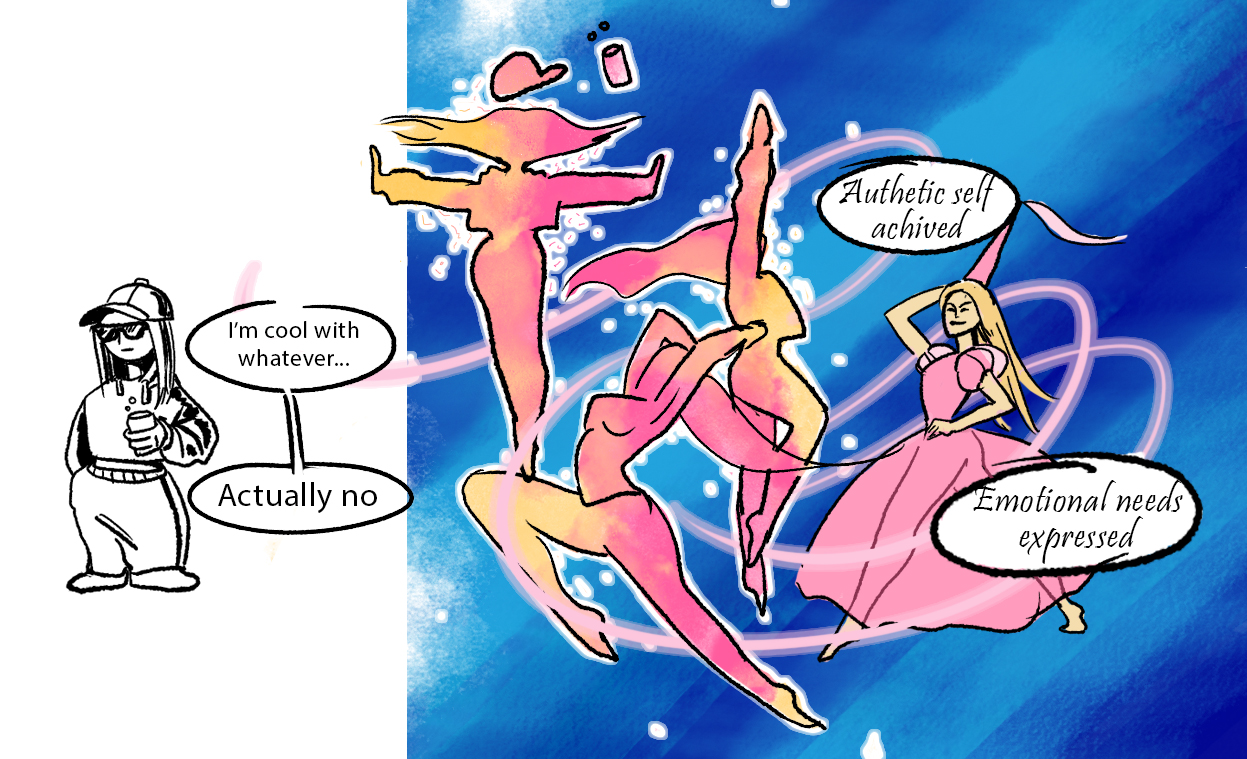
Who is the coolest girl you know? Is she the life of the party, always travelling somewhere exotic, wearing so many bangles you hear her before you see her? Probably not – she would be “quirky”. Maybe she is the girl who wears glasses, a book in hand, always answering in class? Probably not – she is “nerdy”. Is she tall and lithe, into male-centered sports, drinks beer, and never ever makes a scene? Now she is cool. Maybe you know her, maybe you do not. Maybe you have tried to be her. Either way, you undoubtedly know the fantasy. Well, somewhere between Stanley cups and sock curls, a new trend is in: the “cool girl” is officially out.
For nearly a generation, “Cool Girl” was not just a type; it was the blueprint. She was the girl who ate hamburgers and somehow still looked like a supermodel. She watched football and drank beer. She was low-maintenance, high-reward, and never made anyone uncomfortable. She was entirely an illusion. Pop culture of the 1990s and 2000s practically mass-produced her. She was Cameron Diaz in There’s Something About Mary and Megan Fox in Transformers. But it was David Fincher’s 2014 film Gone Girl that finally gave her a name. In her now-iconic monologue, Amy Dunne laid the trap bare. “Men always say that as the defining compliment, don’t they? ‘She’s a cool girl.’ Cool Girl is hot. Cool Girl is game. Cool Girl is fun. Cool Girl never gets angry at her man.”
Psychologically, the Cool Girl trope was a brilliant defense mechanism masquerading as female empowerment. It offers an irresistible bargain: “If I become everything that is easy to love, maybe I will never be too difficult to keep”. In a culture where women have been rewarded for being accommodating, agreeable, and endlessly pleasant, performing effortlessness often feels safer than expressing your actual needs. But the problem with pretending to be low-maintenance is that eventually, people begin treating you as though you do not have any needs at all.
To be a Cool Girl, you had to actively separate yourself from “other girls” – the ones who were “dramatic”, “high-maintenance”, or “too much”. Psychologists have long pointed out the burnout associated with this kind of emotional masking. When you suppress your boundaries, anger, or desires to avoid being labeled “crazy” or “nagging”, you are not actually building or protecting your relationships – you are just slowly abandoning yourself.
The Cool Girl facade also required a staggering amount of hyper-vigilance. You had to monitor your tone, your weight, your appetite, and your reactions. It was exhausting. And the reward? Being tolerated for who you were pretending to be, rather than being loved for who you actually were.
Thankfully, the script is changing. Instead of striving for effortless perfection, the current cultural spirit embraces the messy, the hyper-feminine, and the intentionally “too much”. We are less interested in women who are effortlessly agreeable and far more interested in women who are unapologetically themselves. TikTok trends are less about being the chill girlfriend and more about sharing emotions, celebrating girlhood, or admitting to highly specific, wonderfully uncool anxieties.
Dropping the Cool Girl act is not easy. It means risking rejection. It means admitting you care, asking for reassurance, setting boundaries, and accepting that not everyone will like the real version of you. But maybe that is exactly the point. Maybe the coolest thing a woman can do today is not pretending she needs less. Maybe it is refusing to apologise for needing anything at all.
The Cool Girl is dead. Long live the real one.

Visual: Jemma Thomson
