
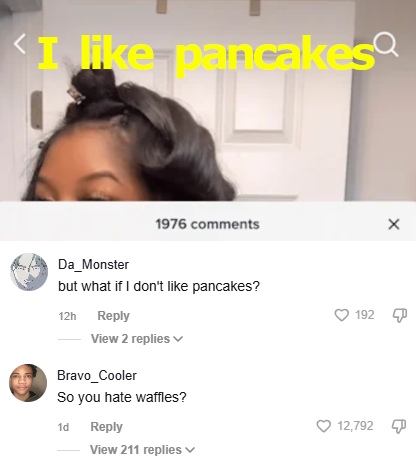
Someone posts a video about their experience of something. Nothing particularly controversial. Nothing directed at you. Nothing requiring your immediate intervention. Yet, somehow, within five minutes, the comments have become a town hall meeting about why the video does not represent you.
“Okay, but what about people who…?” “I don’t actually like beans.” “Why isn’t there an option for…?” “But this is not my experience…”
Welcome to the internet; have a look around. Specifically, let us look at the bean soup theory. As explained by Merriam-Webster, the phrase comes from a viral TikTok about bean soup. The original creator shared a recipe and commenters began explaining that they did not like beans and asking for alternatives. The recipe was not aimed at people who hate beans. Nevertheless, the comments apparently needed to establish that fact.
This is not about soup. It is about our increasingly powerful instinct to make everything about ourselves. A post can be about one person’s experience, a particular cultural group, a niche hobby or an incredibly specific situation, and somewhere in the comments someone will inevitably arrive to announce that it does not apply to them.
The phenomenon taps into a broader issue of context collapse, which is the digital phenomenon where distinct social circles, audiences and personal identities merge into one single, flattened communication space. As Encyclopedia.pub explains in its discussion of social media and context collapse, online platforms bring audiences together that would ordinarily exist separately. The result is that something intended for one group can suddenly be consumed by everyone from your closest friends to complete strangers.
Suddenly, a conversation that was never yours feels like one you need to have an opinion on. We want to see ourselves represented. We want to feel included. Social media has also trained us to constantly ask where we fit: Do I look like this person? Do I agree with them? Does this apply to me? Would I do the same thing?
The problem is when the answer is “no,” and we treat that as an issue with the content rather than simply accepting that it was never made for us.
As highlighted in the piece written for the site Medium, Remember the Bean Soup Theory? Well, Here Is My Take, the phenomenon highlights how easily we centre ourselves in conversations that were never actually centred on us.
This is one of the stranger consequences of having our own personalised little corners of the internet. Algorithms give us content based on what we like, what we watch and what we engage with. We are constantly shown things that are supposedly for us. Eventually, we start expecting everything to be tailored to us, but not everything has to be.
Someone else’s experience does not become any less valid simply because it is not our own. A video made for one group does not need to make room for every other group, just as a story does not need to contain every possible perspective before it is allowed to be told.
Maybe we have become so accustomed to seeing ourselves reflected in everything that we have forgotten that not everything is meant to reflect us. Sometimes, something can simply belong to someone else. We can listen without inserting ourselves, recognise that an experience exists without making it our own and let a story remain where it began.
Not everything needs our opinion. Not everything needs our correction. Sometimes we can simply keep scrolling.

Visual: Daniel Green
