
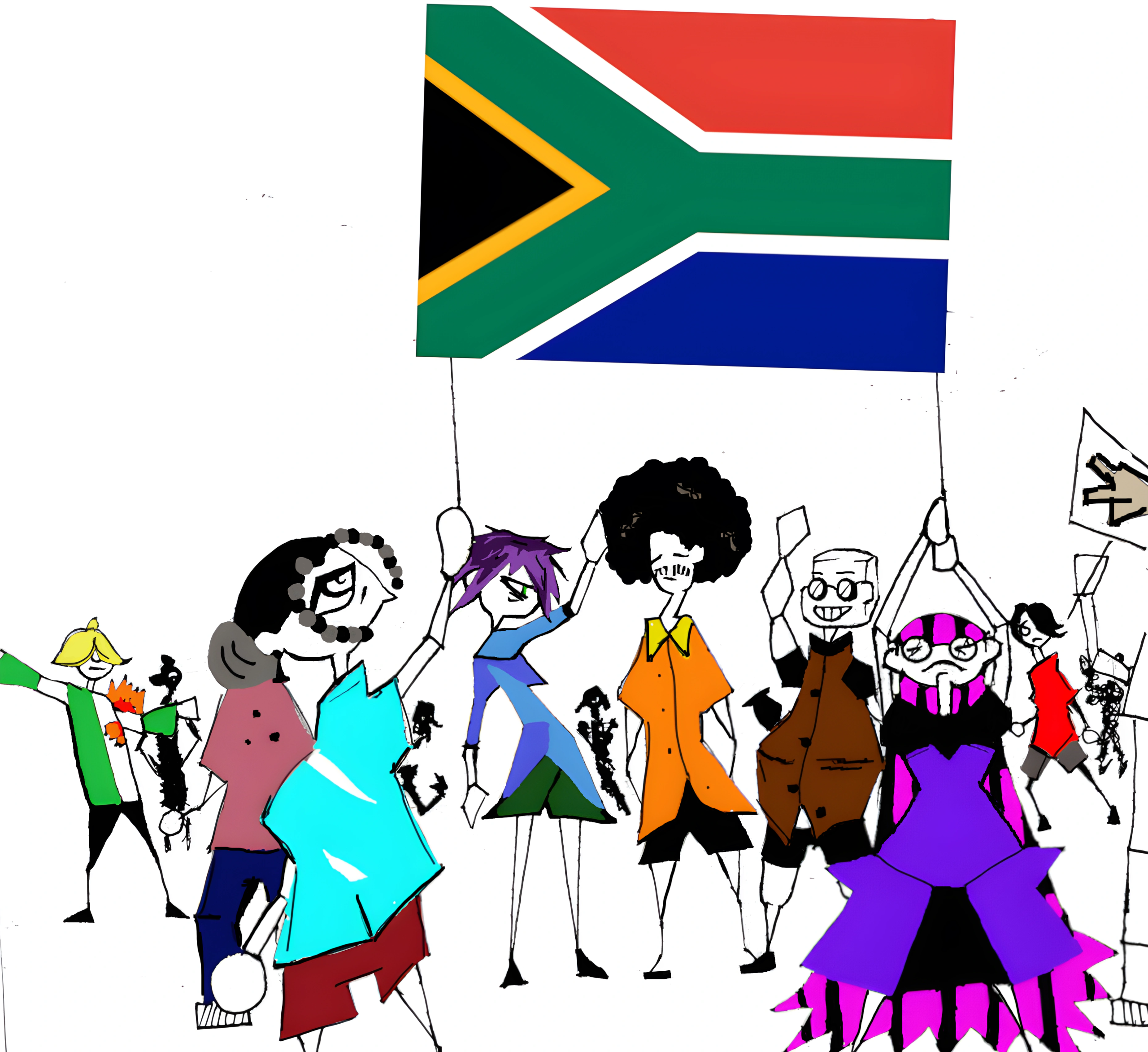
Most people grew up hearing the stories of how, on 16 June 1976, students marched in the streets of Soweto, protesting the decree that their education would be delivered in Afrikaans. Even if they were allowed to vote, they were not old enough to do so. And yet, they left their mark on history. That march, met with bullets and violence, paved a long, painful road toward the 1994 elections and the dawn of democracy. Here we are, fifty years later. Many seem to ask why this still matters, and the answer is simple: because the story is unfinished.
A feeling repeatedly expressed by the youth of today is that South Africa has reached a new moment of reckoning. “Something is about to hit us again,” warned Tebogo Suping, a young activist. With hunger, poverty, violence, corruption, and skyrocketing unemployment plaguing the country, it is hard not to feel dejected at the state of things. The feeling of today’s youth is starkly juxtaposed with the passion of rebellion in 1976.
The 1976 generation had clarity regarding their enemy: Apartheid was visible and nameable, and its instruments – the batons, the bullets – were concrete. Hector Pieterson’s photograph does not need any explanation. The injustice announced itself, and that clarity is what made the rebellion so galvanising. At that time, you knew what you were marching against.
Fifty years later, the crisis is just as real but harder to photograph. Hunger and unemployment do not wear a uniform. Corruption dissolves into systems, tenders, and middlemen. The enemy is structural, and sometimes, it wears the face of liberation itself.
What makes this moment different is that today’s youth have inherited both the victory and the betrayal of 1994. We were handed democracy as a birthright and then watched it struggle to translate into dignity. The marchers of 1976 were fighting for something. We are fighting to hold onto what was promised and never fully delivered.
However, we are not alone. The South African youth are a part of a global tremor. Across the world, a generation is refusing to be quiet about its dispossession. Globally, youth-led uprisings have driven thousands from their screens to the streets, demanding accountability and, in some cases, toppling governments. In 2024, student protesters in Bangladesh brought down a sitting government. In Nepal, Morocco, Madagascar, Peru, and beyond, a singular message has emerged from young people: governments are failing to meet their most basic obligations.
For as long as there have been protests, young people have led the charge – from the student uprisings of May 1968 in France to the Civil Rights Movement in the US. Today’s youth have something our predecessors did not: digital tools that enable decentralised, real-time co-ordination, rapid information sharing, and viral symbols that unify diverse groups across the globe. The result is movements that are harder to silence, co-opt, and ignore.
Research from Harvard Kennedy School has found that if a nonviolent campaign has extensive youth participation, it is over twice as likely to succeed than campaigns with limited youth participation. The research shows that young people are especially committed, creative in their tactics, and capable of building coalitions across social and cultural divides. One expert noted that this generation feels “short-changed”, with their interests consistently left unrepresented.
What connects Lagos and Johannesburg is not geography. It is the broken social contract, the experience of being young and educated enough to understand what you are owed, and watching those in power look the other way.
According to Statistics South Africa, from 1996 to 2022, the total youth population rose from 14.7 million to 21.6 million. Young people between the ages of 18 to 34 now constitute a third of the total population of the country. This is not a minority voice at the margins of the national conversation. This is the national conversation.
This voice has been systematically under-represented where it matters most. Of the approximately 9 473 councillors elected in the 2021 local government elections, only 1 421 (15%) were people younger than the age of 35. The very people making decisions about service delivery, water, schools, and the streets where the youth live and die are overwhelmingly not young themselves. This is not a representational failure. It is a governance failure. Decisions made without the voices of those most affected by them are decisions made in the dark.
In an interview with The Post, Caitlyn Paddy explained that the political system does not benefit the majority of South Africans. It benefits a privileged, connected few. Real change, she argued, demands that young South Africans organise not only as voters, but as cultural and political agents capable of imagining and building alternatives to the systems that have failed them. We are the architects of the society that comes next. When it is directed, our energy, rage, and vision are the most powerful resources the country has.
On 4 November 2026, South Africans will go to the polls to elect local government councillors. These are the leaders that are responsible for governing municipalities and overseeing the delivery of basic services at a local government level. Local government is where democracy is most intimate and most felt. It is also where it has most visibly failed.
The first voter registration weekend in June recorded over 477 000 new voter registrations, with 80% coming from those under 30 years old. That number is not just a statistic. It is the sound of a generation that has not given up.
The students of 1976 did not march because they believed the system would listen. They marched because they refused to be silent. The result was not immediate. South Africa’s unfinished business is not a new failure. It is the original wound, still open. However, we could be the generation with enough numbers and fury to close it.
The question is not if the spirit of 16 June still matters. The question is if we will find our own rebellion through moments, ballots, and the refusal to accept the current state of our country.
Visual: Daniel Green
