
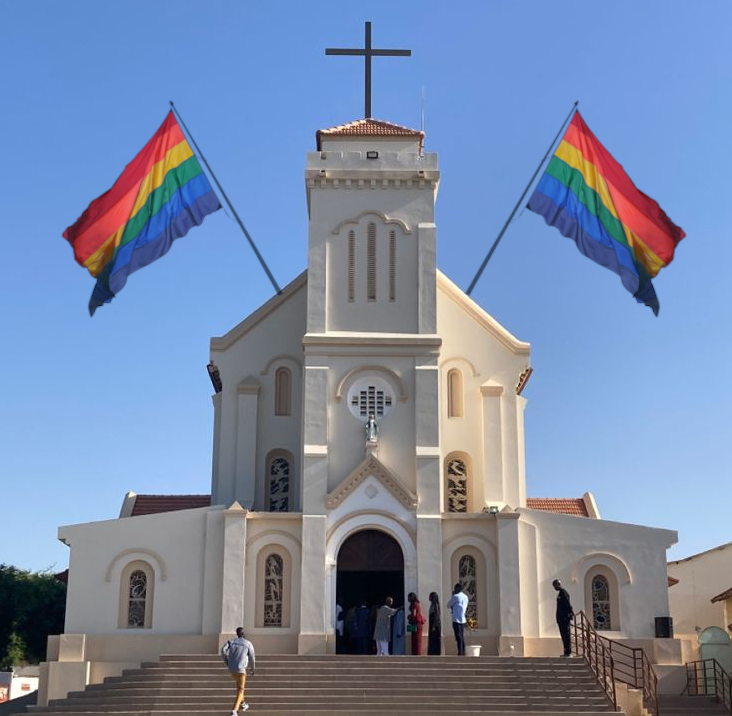
For a lot of LGBTQ+ Christians, church doesn’t feel like two separate parts of life sitting comfortably side by side. It feels like a choice nobody should have to make: be honest about who you are or stay welcome in the community that raised your faith. Plenty of people end up doing both badly, quietly editing themselves every Sunday just to keep their seat in the pew. That uncomfortable duality sits at the core of a much larger question South African Christianity hasn’t fully answered yet: is there actually space for LGBTQ+ people in the church or just the appearance of space?
For some congregations, the answer has been a clear yes. The Reforming Church in Pretoria, led by Pastor André Muller, was built specifically for gay Christians who’d been failed elsewhere, and getting there was not a smooth journey. It started in a gay club, then moved outdoors when that club shut down, with the then-small congregation meeting in a park for a while before finally finding somewhere permanent without much support from the wider Christian community along the way. That kind of instability sinks most new churches before they get anywhere, yet it did not sink this church. More than three decades later, it’s still one of the clearer examples of a church that stopped merely tolerating queer members and actually built itself around including them.
But that full inclusion is still the exception, not the rule. According to The Conversation, genuine inclusion depends on far more than a friendly welcome at the door. It means leadership willing to speak publicly rather than staying silent, a church that doesn’t treat queerness as a problem that you can “manage” and everyday choices such as who leads prayer or whose relationship gets acknowledged from the pulpit that back the open-armed welcome instead of quietly shunning it out. Getting all of these to line up is a rare occurrence.
More often, LGBTQ+ Christians describe something closer to conditional acceptance. You’re allowed in the building, but maybe not behind the pulpit. You’re tolerated, but your relationship stays unspoken. According to openDemocracy, in “African activists show how churches can make space for queer people,” activists across the African continent have described this exact pattern, a kind of welcome that only holds up if queer members agree to shrink themselves down.
Some bigger, more traditional denominations are shifting, though unevenly and slowly. According to GoodThingsGuy, the Methodist Church of Southern Africa formally affirmed LGBTQI+ rights, becoming one of a small but growing number of denominations changing their official position in recent years. It’s a meaningful shift on paper, though it doesn’t automatically translate into every local congregation feeling different on the ground.
That gap, between what a denomination declares and what an individual actually experiences walking into their local church, is really the heart of this story. A national statement of affirmation doesn’t guarantee a warm welcome in a small-town congregation still working through its own discomfort. Inclusion, it turns out, isn’t something a church can announce once and be done with. It has to be practised, repeatedly, at every level, from the pulpit down to the person sitting next to you in the pew.
So where does that leave LGBTQ+ Christians right now? Somewhere in between, mostly. Progress is real in places like the Reforming Church, and real too in denominations formally shifting their stance. But for many LGBTQ+ believers, belonging still depends entirely on which door they happen to walk through on a Sunday morning and whether that door was ever really open to them in the first place.
Image: Sourced
