
Cinema has a strange way of making the world feel smaller. For ten days this September, that is the goal of the European Film Festival South Africa, which lands in Johannesburg, Cape Town, Durban, and Pretoria from 17 to 27 September, bringing with it twelve films from twelve countries and a theme that hits closer to home than you’d expect: family.
Now in its 13th year and produced by the Encounters South African International Documentary Festival, the festival has built a reputation as something more than a showcase of subtitled arthouse films for the culturally curious. It is a cultural exchange dressed up as a night out at the cinema. This year’s line-up draws from Belgium, Denmark, France, Germany, Ireland, Italy, the Netherlands, Poland, Portugal, Spain, Ukraine and the UK, with Ukraine’s entry made possible through backing from Austria, Flanders, the EU and the UK.
“Family” as a theme is not a soft one. It is family in all its complicated, unglamorous forms, which are biological, broken, chosen, rebuilding. You’ll find it in the festival’s opener, The Last Viking, a blackly comic Danish crime caper starring Mads Mikkelsen as one of two brothers untangling old secrets. You will find it further in Fatherland, director Paweł Pawlikowski’s Cold War-set road trip between a German father and daughter, and in My Father’s Shadow, the BAFTA-winning debut following a dad and his two sons through Lagos on the eve of political upheaval. Spain brings Javier Bardem in The Beloved, the Netherlands offers A Family with Carice van Houten, Poland enters with Agnieszka Holland’s Franz, Ireland with Christy, Portugal with Aquí, loosely based on J.M. Coetzee’s Jesus trilogy, of all things, and Italy rounds the festival out with Paolo Sorrentino’s La Grazia. Ukraine’s Porcelain War and France’s Colours of Time fill out the twelve.
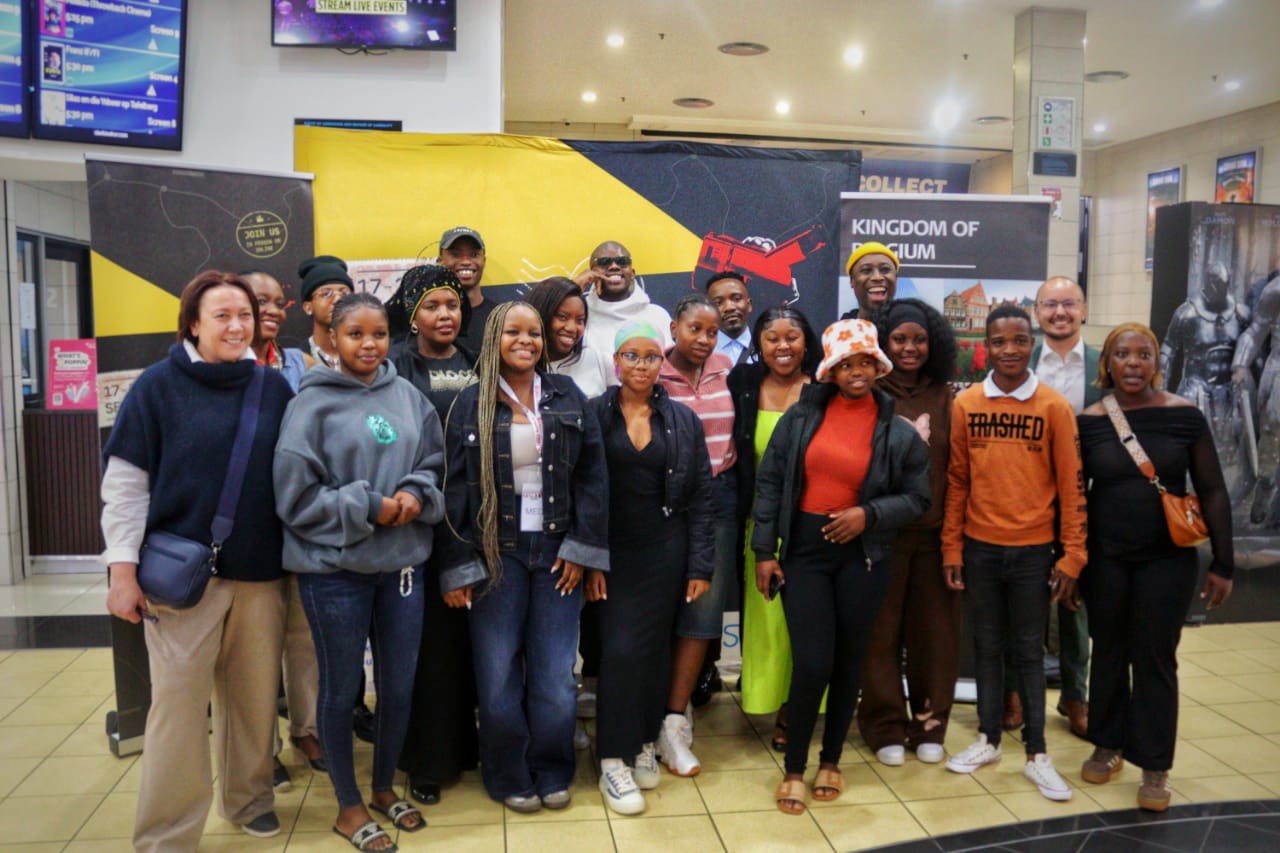
But if one film carries the theme on its shoulders, it is Belgium’s Young Mothers, which the PDBY had the privilege of viewing.
Filmed inside an actual home for young, single mothers, the movie doesn’t dramatise teenage pregnancy so much as sit with it, refusing easy judgement, showing the women behind the label instead. Speaking at the screening, a representative from the Belgian embassy explained why the film mattered enough to bring across the world. Young mothers, he stated, are too often reduced to hardship and shame, whether in Belgium, elsewhere in Europe or here in South Africa. Young Mothers asks audiences to look past the stereotype and see the person – someone still trying to build a future for herself and her child against odds that would break most people.
He put it simply: the festival works like a bridge. Distance does not erase the fact that we are all carrying versions of the same stories. That is the whole spirit of the event in one line.
If you need a reason to go beyond a good film and a decent popcorn combo, the PDBY has one for you. The PDBY is running a competition on our Instagram tied to the festival, so keep an eye on the page if you want a shot at getting yourself a seat.
Honestly, though, you do not need convincing beyond the films themselves. There is something quietly comforting about sitting in a dark room with strangers, watching a mother in Belgium or a father and son in Lagos wrestle with the same messy, ordinary love that shows up in every home, everywhere. Young Mothers says it loudly: behind every label we hand people, there is someone doing their best with what they have got. You do not need to speak French or Flemish to feel that, you just need to show up.
So show up. Grab a friend, grab a ticket, and let the festival do what it does best: remind you that “over there” isn’t as far as it seems, and our stories transcend borders.
Visiual: Anita Solarin
