

The Women’s March of 1956 stands as a poignant marker of the immense impact that women had on the Anti-Apartheid Movement. However, protest art, or “artivism”, is a quiet thread that consistently runs through every movement. In many conversations regarding activism, especially in South Africa, the focus tends to be on traditional means of protest such as marching, boycotting, petitioning, or more radical means. However, women in art play(ed) an important role in bringing awareness or inspiring societal change through artivism.
The London Art Exchange defines protest art as “a tool to express beliefs and values, conveying a particular message or highlighting a cause”. Various artforms can be used to convey a story or social commentary. This may include street art, poetry, music, film, or posters and paintings. At its core, protest art aims to amplify the voices of an oppressed people, question the status quo, and plant the mental seeds for revolution.
Art is known for its ability to directly appeal to human emotions. Unlike political texts or speeches, art can immediately inspire action within people of varying levels of education and backgrounds. Furthermore, people are naturally creative and resourceful. While most protest action needs a significant amount of planning and funding to successfully occur, art is often more accessible and common. As a result, art is especially powerful because of its ability to resonate despite immense suppression. For example, South African anti-apartheid activist Govan Mbeki famously wrote large parts of his magnum opus The Peasants’ Revolt on rolls of toilet paper while he was held in solitary confinement, awaiting trial. The rolls were then smuggled out and typed up for publishing in London. This serves as an extraordinary example of how protest art is most effective due to its reliance on resourcefulness and perseverance.
Furthermore, art’s ability to transcend language barriers to evoke emotion and inspire revolution is not to be underestimated. Mary Sibande’s use of sculpture and photography to raise awareness about the issues faced by impoverished Black South African women who are coerced into domestic work uses many non-linguistic cues. Her palette has predominantly used the colour red to symbolise the anger experienced by South Africans as a result of continued poverty and inequality.
In the digital age, protest art is also widely effective as it is easily shareable. In comparison to marches that may be location-constrained, a photograph has the ability to reach millions across the globe. Art often has the ability to bypass authority and censorship. From sneaking rolls of toilet paper to sharing protest music to other countries, protest art is often a more lucrative way to spread awareness under duress.
South African women have long used artivism to assert themselves. The world will never forget Miriam Makeba or Letta Mbuli who used their gifts as singers to expose the ills of apartheid. More recently, there has been the iQhiya collective. In 2015, a group of female performance art students from the University of Cape Town formed in response to their male counterparts receiving more attention and opportunities. These are just a few examples of the role played by South African women in protest art.
As in many fields, female activists (particularly Black women) are regularly given very few pages in history books in comparison to their male counterparts. However, the legacy of the Women’s March of 1956 stands as testimony to the power that women can harness through both activism and artivism.
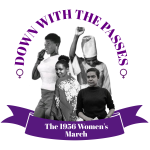
Visual: Khanyisa Motsepe
