
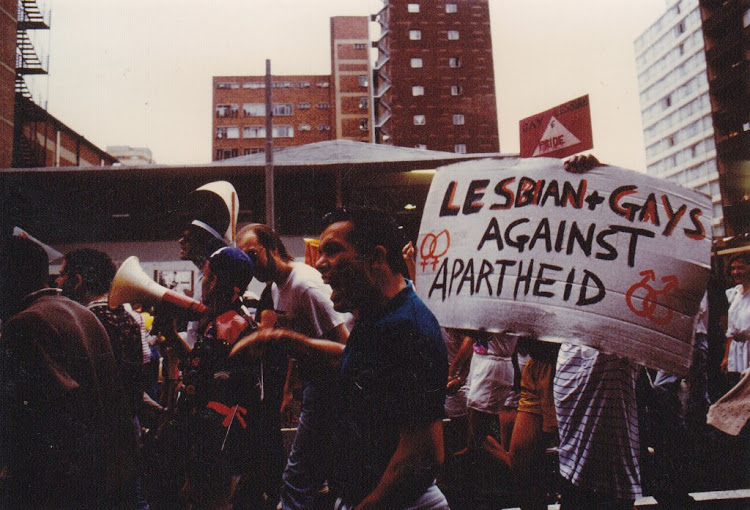
October sees the celebration of South Africa’s Pride Month. This is to commemorate the first Pride March held in both the country and the continent. When discussing liberation efforts, many activists have expressed the importance of focusing on intersectionality. In SA, the fight against racial discrimination was as important as the fight against that of discrimination against gender and sexuality.
The Apartheid regime was not kind to the queer community. South African History Online details that under the National Party, homosexuality was a crime punishable by several years in prison. The party’s main fear of racial intermixing made them nervous about what they thought to be the “grey areas” of sexuality transgressions. Most infamously, a 1969 amendment to the Sexual Offences Act of 1957 criminalised men who engaged in any form of sexual conduct when more than two people were present; this was used to outlaw LGBTQ+ events and placed a target on the backs of gay men.
As a result of this policing, SA’s queer community found innovative ways to assert themselves. This led to the birth of a pseudolanguage called “Gayle” or “Moffietaal”. It is made up of a mix of Afrikaans and English with the use of popular women’s names as code words for activities that were illegal to discuss openly. While there is contention over its origins, with some debating that it was born out of prison, it is widely accepted that it came from the Coloured gay community of District 6 in Cape Town. It acted as a code for the LGBTQ+ community to communicate openly without detection under the government and social duress that they were under. It offered them protection especially in heterosexual or other spaces that put their safety at risk. For example, Betty Bangles referred to the police. The lesbian community was also recognised for developing their own variation of Gayle named “Lettytaal”.
This is a testament to both the difficulty that the queer community faced whilst living under the Apartheid regime and their creativity in still creating identity and community for themselves despite it all.
Gay activist Simon Nkoli stands as one of the most respected figures in the intersecting fights against homophobia and racism in Apartheid South Africa. After being in the predominantly white Gay Association of South Africa, that ironically claimed to be apolitical, he founded the Gay and Lesbian Organisation of the Witwatersrand (GLOW). The organisation aimed to create a “non-homophobic, non-racist and non-sexist” space for the queer community in Johannesburg. GLOW would go on to organise Africa’s first Pride March in Braamfontein.
The Pride March occurred on 13 October 1990. Despite still being under Apartheid, 800 people marched through Johannesburg. Many did this while wearing masks and paper bags over their heads to prevent being identified or targeted by the Apartheid regime.
Nkoli firmly believed in the importance of a parallel, intersectional fight against Apartheid. Before the march, he was quoted saying: “I am Black and I am gay. I cannot separate the two parts into secondary and primary struggles. In South Africa, I am oppressed because I am a Black man and I am oppressed because I am gay. So, when I fight for my freedom I must fight against both oppressors. All those who believe in a democratic South Africa must fight against all oppression, all intolerance, all injustice.” His efforts were also instrumental in getting the ANC to acknowledge and publicly support gay rights in the South African constitution.
Pride was an integral, yet underrated, thread that ran through the Anti-Apartheid Movement. SA’s Pride Month is important to continue honouring and creating discussions around the still socially ostracised queer community in both our country and continent. This month honours those who have been lost, the beauty of the community and the continued fight for social acceptance. As American civil rights activist Fannie Lou Hamer said: “Nobody’s free until everybody’s free.”
Image: Sourced
