
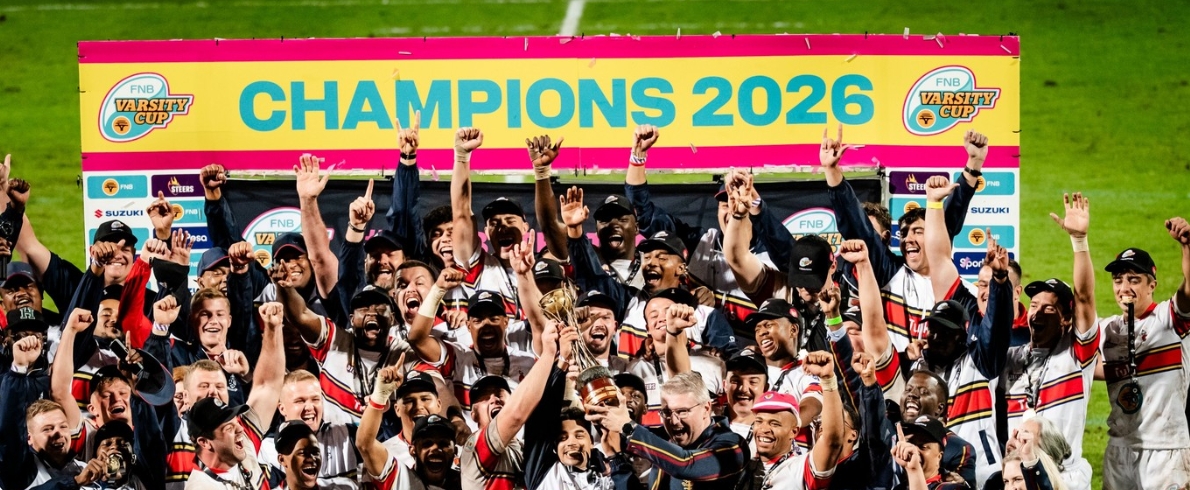
There are nights in sport that give you a result. And then there are nights like these – nights that give you something far deeper. Something that lingers long after the final whistle, long after the rain stops falling, long after the lights go out at Tuks Stadium.
On Monday, 13 April 2026, in front of a packed and rain-drenched crowd, FNB UP-Tuks did not just win a rugby match. They did not just secure a record sixth Varsity Cup title with a dominant 31–3 victory over the FNB NWU Eagles. They told a story.
A story of pain. Of brotherhood. Of belief. Of a promise made, and a promise kept.
But the scoreboard alone cannot capture what this night truly meant. Because this was never just about rugby.
The Weight of the Past
To understand this victory, you have to understand where it began. This is a Tuks side that knows what it means to fall. A group that, not too long ago, found themselves in the Varsity Shield – far from the spotlight, far from the glory.
But sometimes, it is in those moments, away from the cameras, where the strongest teams are built.
Captain Dillon Smith reflected on that journey with raw honesty. “I don’t have words to describe it… This whole group has gone through a tough time. About 50–60% of this group was together during that Shield year… So we’ve come through hard times together.”
There is something unbreakable about a team that has suffered together. It creates more than just chemistry – it creates brotherhood. And that brotherhood carried them all the way back to the top.
There is something powerful about shared struggle. It forges bonds that cannot be replicated in easy victories. It creates teams that are not just teammates, but family.
And on this night, that family had something to show for it. And Smith could not be more proud of his family. “This is just so special, to have something to show for it at the end of the day. I’m really so proud of these guys. I love them… what a group of gentlemen – together, and on the field… animals.”
A Final Begins in the Rain
The stage was set at Tuks Stadium. The stands were packed. The rain fell relentlessly. And yet, no one moved. Because this was more than just a final – it was a moment.
From the first whistle, the intensity was undeniable. NWU came out firing, applying early pressure and silencing the home crowd with the opening points of the match. MJ Mostert slotted a penalty in the 18th minute, giving the Eagles an early lead.
For a moment, doubt crept in. But champions do not panic – they respond. Divan du Toit stepped up, calmly slotting a penalty to level the scores. From there, Tuks began to assert themselves – not with flair, but with force.
Their forward pack took control. Carry after carry. Phase after phase. Pressure building like the storm above.
And then it broke. A penalty try. Seven points. Momentum. Tuks led going into half-time, but the game was far from over.
The Second Half: A Statement of Intent
If the first half was a battle, the second half was a declaration. Tuks came out with purpose. With clarity. With hunger. They squeezed the NWU defence, turning pressure into points.
Then came the moment that lifted the stadium.
Andile Myeni – electric, fearless – sliced through the defence in a breathtaking solo run to score a point-of-origin try. It was the kind of moment that defines finals. The kind of moment that turns belief into certainty. Jean Fourie followed, crashing over the line as UP extended their lead. The rain kept falling. The crowd kept roaring. And Tuks kept coming.
Du Toit, who had earlier missed conversions in the difficult conditions, redeemed himself with a massive 50-metre penalty before adding further points to put the result beyond doubt.
31–3.
But numbers do not tell the story. For the players, this was never just about the scoreboard. It was about something deeper. Something emotional. Something personal.
Oelof de Meyer captured it perfectly. “It means everything, everything to us as a team… We’ve been talking all year, and even last year, about family and brotherhood.”
At the start of the season, they made a promise. “We made a promise to each other that we were going to win… and the fact that we’ve won shows you just how much this means to us.”
And in that moment – standing on the field, soaked in rain and glory – that promise became reality.
The Meaning of the Stripe
If there was one word repeated throughout the night, it was “special”. Not in a cliché sense, but in a way that carried weight.
Smith said it simply. “This is a special place. This is a special field. This is a special university, and it’s a special jersey to represent.”
For Oelof, it was even more personal. “I came to Tuks straight out of school, and since then, this jersey has meant everything to me… This stripe is everything to me. It’s going to shape my rugby career. So I would give my life for this stripe.”
That is what Varsity Cup does. It reminds players why they started. It reminds them who they represent.
The 16th Player
While the players delivered on the field, something equally powerful unfolded off it.
The rain did not stop the crowd. If anything, it made them louder.
Steven Ball, Director of Sport, reflected on the atmosphere. “The boys on the field played unbelievably… but the 16th player – the students, the alumni, the fans – they just came out to support. Even when it was bucketing down with rain.”
In the stands, belief was not quiet. It was deafening. Ruan Potgieter from House Mopane summed it up with passion. “The vibe is unbelievably big – you guys should see it… Tuks is obviously going to win… they’re going to run over them… It’s Tuks or niks.”
And on this night, it truly was.
More Than Just Rugby
What makes Varsity Cup special is that it is not just about rugby. It is about identity. About belonging. About something bigger than the game itself.
Francois Pienaar, former Springbok and Founder of Varsity Cup, reflected on this. “Not only for South African rugby… what it means for South Africa… it’s very special. The crowd is incredible… where can you show support for your university in such a way?”
And beyond the spectacle, there is purpose. “It’s students first and then rugby… you will stop one day – what are you going to do? If you can leave university having played and won, but with a degree, that’s what it’s all about.”
Former Springbok player Steven Kitshoff added another layer to that significance. “It’s a great breeding ground for young talent… it’s the future of rugby, showcasing young players and giving them opportunities.”
Varsity Cup is not just about today. It is about tomorrow.
The Other Side of the Story
In every final, there are two stories. For NWU, this was a night of heartbreak, but also of growth. NWU’s Schalk van Schalkwyk, who has captained the Eagles and was unfortunately injured at the time, reflected on the journey. “As a team and a player group, it’s very special for us to be here… we wanted to take the next step, but it’s still special.”
And even in defeat, there was gratitude. “Thank you for the support [throughout] the year… we will be back next year and we will become stronger.”
Because that is sport. It gives. And sometimes, it takes.
A Night of Emotion and Unity
As the final whistle blew, emotions spilled over. Players embraced. Some celebrated. Some stood still, trying to process what had just happened. Francois Pienaar described the scene: “You see the tears in the eyes… the emotions… the disappointment in those who have lost. But that’s sport. That’s what sport gives you.”
And in those moments, something powerful happened. Not just victory, but unity.
Steven Ball said it best: “This brings our community together irrespective of your race, your religion, your gender… you have a space to come and support your fellow students.”
On a cold, wet night in Pretoria, the University of Pretoria became more than just a campus. It became one.
Tuks of Niks
This victory is more than a title. It is a statement. A reminder that setbacks do not define you. That brotherhood matters. That belief, when shared, becomes unstoppable.
From Varsity Shield to Varsity Cup champions. From doubt to dominance. From promise to fulfilment.
And as the rain fell and the crowd sang, one truth stood above everything else: This is Tuks.
This was a reminder of what it means to wear the stripe. Because for Tuks, it has never been just a slogan.
It is a standard.
It is a culture.
It is a belief.
Tuks of Niks.

Visual: University of Pretoria
