
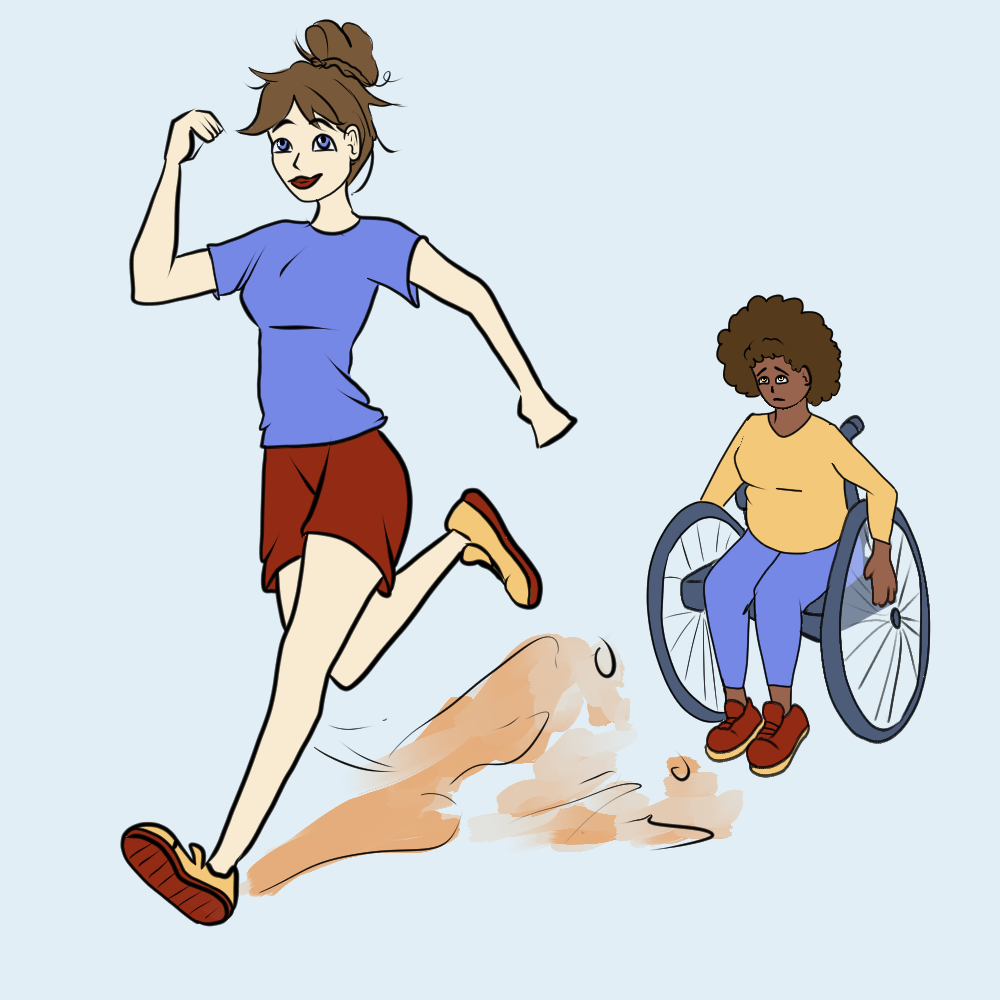
In South Africa, facing barriers to accessing education is a tale as old as time. From funding issues to limited housing options, getting a degree can feel impossible. It can be especially difficult for disabled students who have to use wheelchairs or mobility aids to navigate a campus primarily filled with able-bodied students.
Taking a walk through Hatfield campus, one will notice some accommodations that have been implemented by the university to make it more accessible for disabled students. One wheelchair user described how she finds campus “generally very accessible and moving around alone is fairly easy”. Examples of accommodations include wheelchair accessible ramps, wheelchair accessible seats in some lecture halls, and wheelchair accessible bathrooms. This is in line with the expectations for educational institutions to accommodate disabled students as mandated by the Constitution and other forms of legislation on equality.
Reading about accessibility from the perspective of a journalist may give one the hard facts, but it is important to hear from the personal stories of students who use mobility aids and wheelchairs.
Anonymous #1
“On my busiest days, I wake up early. Getting ready takes me longer because I need to make sure that everything is accessible and that I have everything I need for the day. Once I get onto campus, it takes me time to move from the parking area to my lecture venue because I need to find accessible routes and I have to move my wheelchair across uneven surfaces and steep slopes. The accessible routes are sometimes also longer than the route everyone uses, so it takes me longer to get to classes. Not only that, but I also need to take time to make sure I can get to my classroom and that there is enough space for me to position my wheelchair comfortably.”
Anonymous #2
“Navigating campus does get easier once you know it well, but ramps are slightly steep and harder to use without assistance.”
Anonymous #3
“Some venues are harder to access. While they may have lifts and ramps, some of them only have limited seats that I can access with my mobility scooter. For example, I cannot get up the stairs of Centenary, and I can only sit by the front of the class, so when my classes are full, I have to get onto campus extra early.”
Anonymous #4
“The elevators at Humanities make navigating campus difficult. When I have lectures in room 4-2, which is on [the] lower floor, I need to make sure that I get onto lifts C-F and not A and B, which are on the upper [4th floor]. I have no choice but to use the lift because of my wheelchair, and I basically [have to] hope and pray that I get lifts C-F, which can take a while.”
At times, students who use wheelchairs may require assistance on campus when they encounter inaccessible routes. The university has a designated facility known as Access and Disability Inclusion Services (ADIS) that specifically provides support to disabled students. In addition to this, able-bodied students on campus can also provide some assistance.
Anonymous #1
“Sometimes, I go to venues thinking it is accessible and discover there is an obstacle that makes independent navigation difficult. People offer to help, but this is not always readily available.”
Anonymous #2
“I feel like help is available on campus when I need it. Students can be helpful, and many are keen to assist with the lift.” They went further and said, “Students are polite enough to make way, and they even offer to help.”
However, some able-bodied students can also make it harder for wheelchair users to navigate campus.
Anonymous #4
“Using the lift in some venues can be difficult as able-bodied students will often crowd around the lift and hog the lift when they can see that I am trying to use it.”
Anonymous #3
“I’ve had my mobility aid damaged before in the lift due to overcrowding from students. The fact that the lift gets so full also means it takes longer for me to get to classes.”
Anonymous #1
“Sometimes, people leave their bags or chairs in pathways and end up blocking accessible routes.”
In order for one to access campus, they require accommodation. This is not easy to find when one must search for an accommodation that is close to campus and fitted with the necessary accommodations for a wheelchair/mobility aid.
Anonymous #1
“When you are looking for accommodation, you have to find somewhere that you like that also has common areas, bathrooms, and entrances that are accessible, which makes it more difficult compared to how it would be for able-bodied students.”
Anonymous #3
“My options felt limited when selecting accommodation. I was informed that there were 6 official disabled rooms available from which I could pick as a mobility scooter user. At my current residence, I struggle to access the doors for most common areas as they are often too narrow or too heavy. Some entrances require me to use an access card, but the distance between where I tap and the door is too big. If I were in a wheelchair instead of a mobility aid, I would struggle to make it to open the door on time. Due to these access barriers, I find myself unwilling and unable to participate in my residence activities.”
When asked what students can do to assist wheelchair users, most wheelchair users stressed that students must be courteous when using the lift, giving preference to the elderly and wheelchair or mobility aid users who cannot use the stairs. One said, “I wish students would be more aware of and advocate for disabled spaces.” Students must be mindful and avoid blocking ramps, accessible entrances, and pathways. It is also important that students do not automatically assume that a student requires assistance simply because they are using a wheelchair.
PDBY reached out to Catherine Karusseit, an academic who focuses on the intersection between disability studies and architecture. She sees herself as an activist for disabled persons. Her views are personal and do not reflect those of the university. She believes that it is important to distinguish between “access” and “inclusive education”. Instead of simply prioritising the physical aspects of a building or educational institution, she explained that students must be made to feel as if the institution “welcome[s]” them and as if they “belong”. It must feel as if the campus was “designed” with the lives of students in mind rather than a specific mechanical check box. Karusseit believes that it is important for educational spaces to be accessible to allow people who are disabled to “advance their rights, enjoy equality, and exercise control over their lives.”
It is important to remember, as said by Anonymous #1, that “Accessibility should be something that everyone thinks of”.

Visual: Gabriella le Roux
