
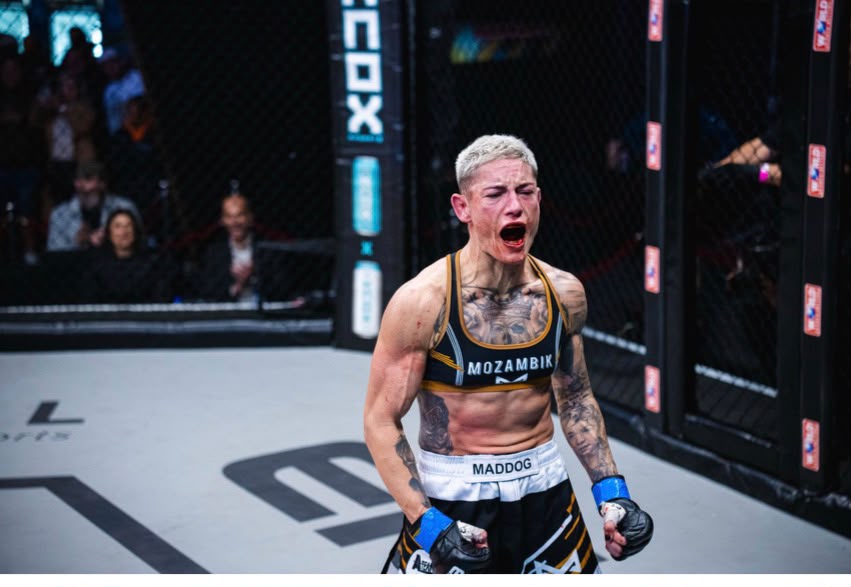
A woman standing in a cage, wearing gloves, waiting for the referee to signal the start of a fight. For many people, that image still feels unfamiliar. Society has long associated women with softness and gentleness while combat has traditionally been reserved for men. Yet every time a woman steps into the cage, she quietly challenges that idea. She proves that strength and femininity do not exist on opposite ends of the spectrum; they can exist in the very same person.
For EFC champion Amanda Lino, fighting has never been about proving that women can do what men do. Instead, it is about proving that women can be unapologetically themselves while competing in one of the most physically and mentally demanding sports in the world. “A massive drive throughout my career has been to help pioneer women’s MMA in South Africa and show that we belong on the biggest stages,” she said. “If my journey inspires more girls to step into the gym, chase their goals, and help create more opportunities for the next generation, then that’s something I’m incredibly proud of.”
Lino’s story is not just one of championship fights and years inside the cage, it is also a story about womanhood. Because while fans see the punches, the victories, and the bruises, they rarely see the realities that come with being a female athlete.
“I don’t think people always realise how much intense training can affect a woman’s body and hormones,” Lino explains. Elite sport demands extraordinary things from the body, and for women, that often means navigating conversations that are still considered taboo. Lino candidly shares how years of training affected her hormones, disrupted her menstrual cycle, and even led her to question whether chasing a career in professional sport would one day affect her ability to have children. “I actually went through the very personal journey of freezing my eggs recently,” she shared. “I was incredibly grateful to find out that my fertility hadn’t been affected. It gave me a lot of peace of mind that I can chase my dream in the cage now while still having the opportunity to have a family one day.”
It is a conversation that is seldom heard in combat sports, but perhaps one that deserves far more attention. Female athletes are not simply smaller versions of male athletes. Their bodies recover differently, their hormones fluctuate, and their training often requires an entirely different understanding of performance and health.
For Lino, recovery has become just as important as training itself. “I train hard, so I have to recover just as hard,” she explained. Access to ice baths, saunas, and professional recovery specialists has become a vital part of her routine, and experience has taught her something many athletes only learn with time: “Rest is just as important as training.” Perhaps the toughest part of being an elite athlete has nothing to do with the physical demands.
Lino has sacrificed birthdays, holidays, family gatherings, and even her twin sister’s wedding in pursuit of her dream. “Success requires putting the sport first more often than not. It’s the hardest part of the [journey].” Despite those sacrifices, she has never allowed stereotypes to dictate her journey.
Growing up, she was constantly drawn to sports that were considered to be “for boys”. Instead of accepting that, she played anyway, even starting girls’ rugby and cricket teams so that other young women could have the opportunities she wished existed. “I’ve never seen being a woman in combat sports as a disadvantage,” she explained. “If anything, it’s been a challenge that’s driven me.”
Perhaps that is what Women’s Month is really about. Not celebrating women because they have succeeded in spite of being women, but recognising the unique realities they navigate because they are women. Amanda Lino’s greatest legacy may never be measured by championship belts or victories inside the cage. Instead, it may be measured by every young girl who walks into an MMA gym believing she does not have to choose between being feminine and being fearless. Because strength has never belonged to one gender.

Visual: Sourced
