
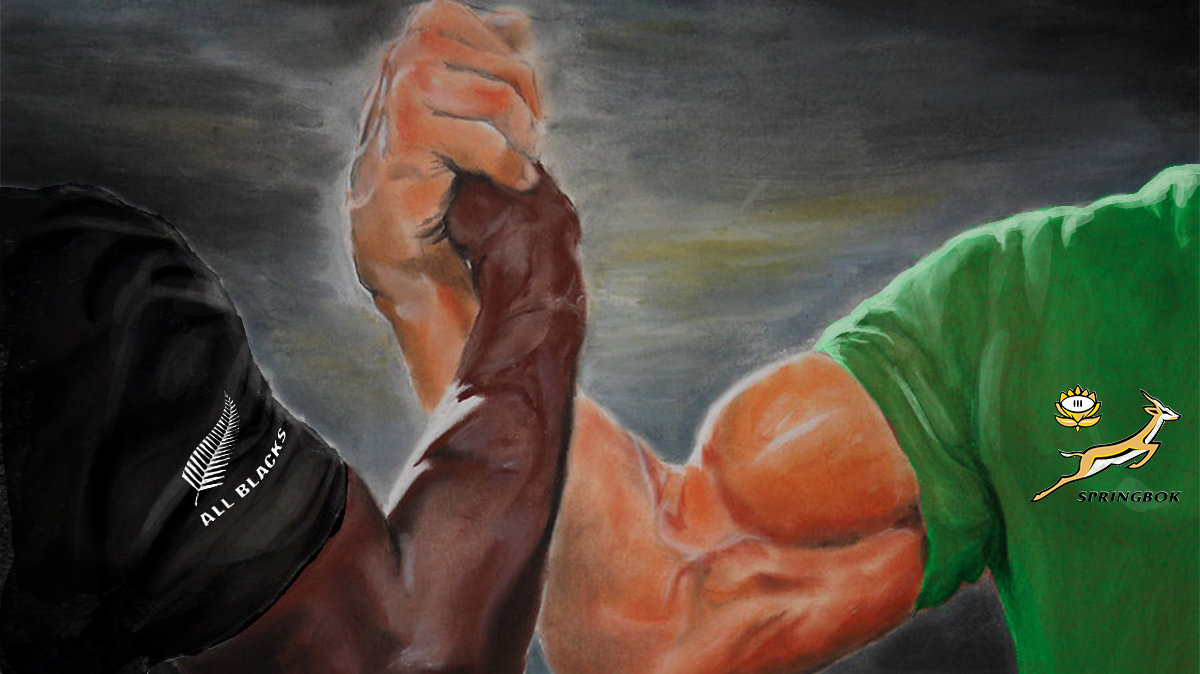
Seeing South African Rugby Through Ruben Love’s Eyes
For 80 minutes, the Springboks and All Blacks are opponents. But beyond the final whistle, Ruben Love sees something far more human.
There are few fixtures in world sport that carry the weight of a Springboks-All Blacks test match. It is a rivalry built on history, physicality and an almost mutual refusal to give the other side an inch. Since their first meeting in 1921, South Africa and New Zealand have produced some of rugby’s most defining contests, including two World Cup finals separated by 28 years.
Yet for all the history attached to the rivalry, the people at its centre know that a rugby match lasts only 80 minutes. For All Blacks player Ruben Love, that contrast is what makes playing against South Africa so special.
He reduced one of rugby’s most celebrated rivalries to its simplest form. “What [playing against the Springboks has] taught me is that it is just about a game of who can endure the most pain for the longest while being accurate,” Love said. It is an unusually simple description of an unusually complicated rivalry.
The Springboks and All Blacks have met 114 times since their first Test in Dunedin, with New Zealand holding the historical advantage in victories. Between them, the two nations have also claimed 7 of the 10 Rugby World Cups played since 1987. But statistics do little to explain why these matches feel different.
The rivalry has survived political upheaval, World Cup heartbreak and decades of fiercely contested Tests. The 1981 Springbok tour of New Zealand became a flashpoint in the country’s opposition to Apartheid, while the 1995 and 2023 World Cup finals added two of the sport’s most enduring chapters to the rivalry.
Now, as the All Blacks returned to South Africa for their first full tour of the country in 30 years, the fixture carries another layer of significance.
For Love, however, the meaning of the rivalry is not found solely in the result. It is found in the relationships that exist underneath it.
“Nothing’s bigger than the game.”
The intensity of the rivalry can make it easy to forget that the players on either side of the halfway line are not so different. They train, sacrifice and compete for the same reasons. They want to win, but they also want to leave something behind for the generation watching them.
Love sees that clearly. “Nothing’s bigger than the game,” he said. “And at the end of the day, we’re all human.”
For a player stepping onto the field against the Springboks, that humanity does not disappear. It simply becomes secondary for 80 minutes.
Love described the experience as one of competing fiercely against players he can simultaneously form genuine connections with. “I just think the connections that you can have with players [in] the Springboks is something special,” he said. That connection is perhaps one of the less visible parts of international rugby. Love also mentioned that he and Sacha Feinberg-Mngomezulu stay in contact quite often.
Supporters experience the rivalry through jerseys, national anthems, tackles and scoreboards. Players experience it differently. They share the same field, the same physical demands and, increasingly, the same understanding of what it means to represent a rugby nation.
For Love, the difference becomes particularly obvious once the game is over. “As soon as you get into the change rooms and you start talking to them, you realise you’re not too dissimilar to each other.” That realisation does not diminish the rivalry. If anything, it gives it greater meaning.
The Rivalry without the Hostility
Rugby rivalries are often sold through division: us against them, one nation against another, one jersey against another. But Love’s perspective offers a different interpretation.
The respect between the two sides exists precisely because both understand what the other is capable of. For 80 minutes, that respect manifests itself as competition. “But make no mistake,” Love said, “for the 80 minutes, we’re trying to dominate and stuff like that.” There is no contradiction in that.
The ability to separate the competition from the person is part of what makes elite sport possible. A player can spend an entire Test trying to overpower an opponent before shaking his hand afterwards. And perhaps nowhere is that contrast more visible than in the relationship between South Africa and New Zealand. The two nations have spent generations trying to prove themselves superior to one another. Yet the very intensity of that contest has created a shared understanding between the players who live it.
Love believes that shared experience extends beyond the players themselves. “You just want to inspire the next generation and everyone’s just living out their own dreams,” he said.
That is the part of the rivalry that does not appear on the scoreboard.
More than a Result
For South African supporters, the All Blacks have long represented the ultimate measuring stick. For New Zealand, the Springboks offer much the same challenge. Neither side can take the other lightly.
That is why Love’s description of the rivalry as a battle of endurance is so fitting. It is not simply about who is more talented. It is about who can withstand more pressure, more physicality and more uncertainty while still executing when it matters.
But there is another measure of success that exists beyond the final whistle. The players become part of something much larger than themselves. Love said that being able to share that experience with the Springboks is “pretty special.”
“We just know that we’re inspiring a lot of people around the world,” he said, “and giving, I think, a lot of people an outlet to watch the games on Saturday with good emotion.”
That may be the greatest irony of one of rugby’s fiercest rivalries. The same game that creates international division can create personal connection. The same players who spend 80 minutes trying to dominate one another can walk off the field recognising that they are not so different after all.
For supporters, there may always be love lost between the Springboks and All Blacks.
For the players, there is something else. There is respect. There is shared experience. And, beyond the final whistle, there is a recognition that the rivalry is only possible because both sides understand exactly what the other brings to the game.
For 80 minutes, they are trying to endure the pain longer than the other side. After that, they are simply rugby players who got to live out the same dream.
Perhaps that is what makes the rivalry matter so much.

Visual: Jemma Thomson
