
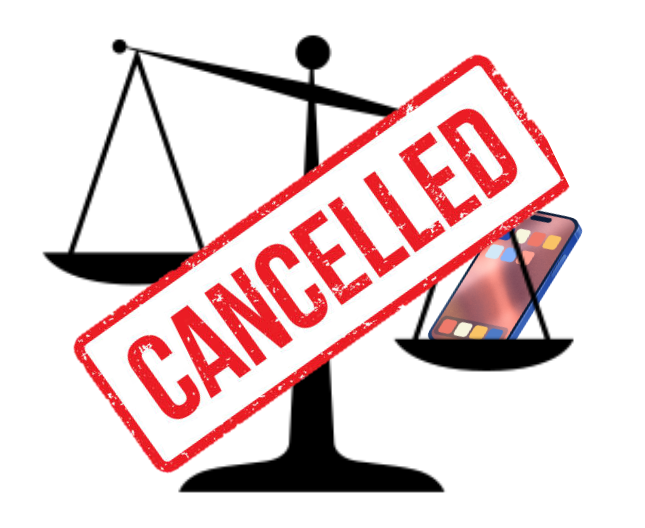
Let’s be honest, the internet never forgets. Since the first Life Orientation lesson we had back in high school, we have always been told that whatever we post online stays there forever, even though the post was deleted. Screenshots have longer lifespans than some campus relationships, and once you’re “cancelled”, it feels harder to come back than finding campus parking at the start of the semester.
Living in the age of digital media and AI has stirred up multiple debates in society about what the term “CANCELLED” actually means. With tweets on X (formerly Twitter) travelling faster than the truth and a rise in parasocial relationships, cancel culture has become a widely debated and complex topic. This word has moved beyond pop culture slang and towards social justice, accountability, and giving power to the people. On the one hand, cancel culture has been used as a digital tool that calls out harmful behaviour, but on the other, it has been criticised for being an act of unforgiving mob justice that leaves no room for growth or redemption. Although some may view cancel culture as a necessary tool for change, others have seen its unforgiving nature that trades dialogue for exile.
According to VICE magazine, cancel culture is “the act of collective boycotting of something or someone after a perceived wrongdoing”. This act is fueled by social media engines and targets public figures, people, things, or brands. However, there is no “one size fits all” when it comes to cancelling. Various groups consider something to be cancelled and others not.
Cancel culture arguably started as a form of grassroots digital activism, but it has evolved into what some argue is a modern-day witchhunt. One wrong word, one misstep, one misunderstood joke, or one post that resurfaces and continues to haunt people years later results in a widespread digital exile and condemnation. Sometimes, it is about taking accountability, like calling out racism, and other times, it is a dodgy joke from 2011 that resurfaces.
We have seen this play out over the years with author J.K Rowling who was cancelled for transphobic comments, makeup and YouTube influencer James Charles who was cancelled for allegations of predatory behaviour and inappropriate messages, and even fashion giant H&M that was cancelled back in 2018 for releasing an advert with a black child wearing a hoodie that said “Coolest Monkey in the Jungle”, which sparked widespread outrage. These are just a few of the many instances that have sparked outrage on social media, resulting in a withdrawal of support from communities and a demand for justice and accountability.
Cancel culture has its downsides, such as isolation, which could cause someone’s mental health conditions to worsen. However, cancel culture is not all bad. It gives power to everyday people to hold powerful figures accountable when the system fails to do so. Sometimes, it prevents people from getting away with saying or doing awful things. Without it, conversations about abuse and sexism would never leave the group chat.
There is a double standard when it comes to cancel culture. While many public figures or brands have been “cancelled”, the effect of their cancellation is often not what people expect it to be. The effects of cancel culture vary by case, and the length of time a person or brand remains cancelled may also differ. If cancel culture is only about exile, we are not working towards retribution and learning curves. When cancel culture focuses on one side over the latter, it can become a larger version of the Hunger Games on a digital platform. I’m sure none of us want to feel like Katniss Everdeen every time we open any social media app.
Alexandra D’amour’s article on cancel culture says, “In a world where we repost moral outrage without the necessary due diligence, it’s important we read between the lines before we effectively “cancel” someone.” Individuals who are not willing to learn from people and problematic situations further cause shame and alienation among people, resulting in a hesitance in the process of learning and unlearning.
D’amour refers to an incident where a white woman was too afraid to participate in a rally for women of colour because she was too afraid to say or do the wrong thing out of fear of being cancelled. The fear of criticism and cancellation should turn into a meaningful, impactful dialogue that results in change. Often, performativity lies in cancel culture where shares and retweets matter more than constructive dialogue or progress. The mob mentality people adopt on social media leaves no room for context, dialogue, and learning. We may find that mistakes, regardless of time passed or severity, are immortalised online, leaving the individual with little room to grow and an inability to learn from their past mistakes or actions.
The question remains: are we holding people accountable, or are we simply exiling them? Yes, it sucks that we might say the wrong thing, but it is important to be open to constructive criticism and to try to be better. Perhaps the solution to this is shifting from cancellation to conversation. Yes, it is important to call people out and hold them accountable, but perhaps, we should also leave room for growth.
