
College has stood for 110 years at the University of Pretoria – a male residence with a rich culture and history that has shaped and grown with the university. As one of UP’s oldest male residences, their influence is unmistakable. Think of the university anthem, the Coat of Arms, RAG, and the many mysteriously missing relics from other residences. By peeling back the layers of truth and myth, this article confronts the proud, problematic, and profoundly human side of College.
Back In Time
Upon its construction in 1915, College was referred to as “the hostel at the College”, and over time, it transformed into Kollegetehuis and then, later, Kollege. According to the UP website, in 2018, Kollege was officially renamed College as a part of the university’s transformation initiatives to become more inclusive and multicultural. As a result of the name change, many College men and College alumni, referred to as Ou Manne, were torn as they felt that College had lost its legacy – a feeling that was further corroborated by the decline in participation and traditions as a result of the COVID-19 pandemic. To many, this simple letter change compromised the name of College, so much so that incoming Executive Committee (EC) member Ncedo Nkhuna aims to strengthen the participation of College men during his term. There is a constant back-and-forth between staying true to the legacy of Kollegetehuis and adapting with the times, especially for the EC members.
During my research, I received a document titled The Republic of Kollegetehuis History Guide, compiled by Louis W. Delport. This is a document created and updated by College men about the history of College. This guide forms the foundation of what every College man learns about their residence. Be that as it may, it is still a guide composed by university students for university students; therefore, it is imperfect and, oftentimes, misleading.
For example, the guide states that in 1939, “Kollegemen bought an old printing press and started their own student newspaper known as the Perdeby.” However, according to the UP Archives, Perdeby, currently known as PDBY, was founded by a group of men who chose to remain anonymous and were only referred to as “The 5 Liberalists”. It is possible that these were College men, but it is also possible that they were not. What further contradicts the information in the guide is the photograph that is hung in the College Museum. This image depicts seven men, instead of five, as the inventors of the Perdeby. And yet, the guide also mentions De Schelftzee, a real and official College bi-annual newspaper predominantly published during the 1960s and 1970s, with many of the publications kept in the UP Archives.
What’s more is that the guide claims that “J.S. van der Linde”, a previous College house father, helped to design the UP Coat of Arms. This is an irrefutable fact confirmed by the UP Archives, however, it is J.S. van der Lingen, not “Linde”. This simple spelling error and other misleading half-truths potentially call the rest of the information in the guide into question. The narrative that College men are trying to cultivate appears misleading.
The Republic of College
According to The Republic of Kollegetehuis History Guide, College established itself as a Republic during 1981 and 1982, after certain groups tried to bring about change that would endanger their “unique spirit and culture”. The title of House Committee (HC) was converted to Executive Committee (EC), and the residence was henceforth run as a democracy according to their Constitution. College is one of the only male residences to declare itself as a Republic, which showcases one way that College marches to the beat of its own drum and ensures that all voices are heard.
Another way that College ensures a democratic residence is through their bi-annual Long House meetings. Long House is College’s “main meeting” for the residence according to Phetolo Pilane, the FeesYaar Minister. During Long House, amendments to the Constitution are proposed and voted upon, and College men are knighted as knighted citizens.
A knighted citizen is someone who is an active participant in the residence’s culture. They choose to uphold and serve the College name. According to Pilane, there are “two ways to [become] a knighted citizen”: you need to be running for EC, or you have to be a semi (a second-year student). Vremies (first-year students) are strongly discouraged from partaking unless they are running for EC. To become a knighted citizen, you must complete two tasks: sleep on the Klippe (the black-painted boulders outside of College) for three nights, and pass the College history test, where they often use The Republic of Kollegetehuis History Guide as study material. After completing these tasks and saying an oath in Long House, College men are officially knighted.
When asked about how being a knighted citizen helps to equip a College man for a leadership position, Luzuko Dawedi, the previous State President, says that they have “more responsibility”, which allows them to adjust to an EC position because as a knighted citizen, you are expected to take on more for the residence. This tradition strives to “challeng[e] the status quo”, as expressed by Nkhuna. Many residences have been exposed to this mind-set on Welcome Day during Orientation Week – the event where residences are first introduced to each other at Rembrandt Hall. College men have a long-standing tradition of sitting stoically in their togas for the entire event. No cheering, no speaking, no laughing, and no smiling. When Nkhuna was asked how he felt about this, he said, “I was actually proud in that moment.” As the College men see it, this display sets them apart from the crowd and honours one of their core beliefs. For better or worse, the men of College pride themselves on being different.
The “Borrowing” Culture
In a nutshell, College has a long history of stealing items and relics from public spaces and other residences. However, they prefer the term “borrowing”, hence the name. It is a practice that has been performed by countless generations of College men and, in many ways, is the essence of the College experience. One notable instance, according to the history guide, is the stealing of the buck statue in front of the Old Arts Building on Hatfield campus in 1985. Upon its return, UP charged the residence for the damages sustained and, in retaliation, College sent a bill to the university for the grass eaten by the inanimate buck statue while it was at College. This example equally depicts College’s relationship with authority figures like UP and TuksRes. When asked how Nkhuna would describe College’s relationship with authority figures, he said, “If you respect us, we respect you. If you do not respect us, then we do not respect you… We do not show you any form of appreciation… We just, sort of, try and make life a bit harder for you.”
The College mascots are simple – everyday examples that showcase how ingrained the “borrowing” culture is at College. These are, now, everyday relics that simply form a part of their building. However, most of the mascots were stolen by College men. Take Oom Gert – one of their oldest mascots that was stolen by four men in 1928 from Van Erkoms Tobacco shop – for example. According to the history guide, most mascots originated similarly to Oom Gert at College.
How does this “borrowing” culture build the men at College? When this question was posed to Pilane, he expressed that “building comes through teamwork”, which creates a “synergy” among the men at College and ultimately teaches “perseverance”. When describing College’s culture, Dawedi asserts, “I would describe it as… a ‘we do not care about what anyone says about us’ [culture].” Indeed, College’s history has proven that when it comes to “borrowing”, this statement has been true for generations.
Conversely, in all of the conversations and interviews I have had with College men, there is a persistent and unmistakable tone of adoration when speaking about their residence. Despite the origin or the method, the residence seems to evoke this emotion within many College men. In my interviews with Luzuko Dawedi, Phetolo Pilane, and Ncedo Nkhuna, I asked each of them, “What does College mean to you?” These were their replies:
- Luzuko Dawedi: “It means brotherhood… I walked in knowing no one but I walked out with brothers.”
- Phetolo Pilane: “It means the world… These guys contributed so much to my life… I always have this sense of: How can I thank them? How can I give back?”
- Ncedo Nkhuna: “I think that [being] part of College is being part of a… family.”
A Night to Remember
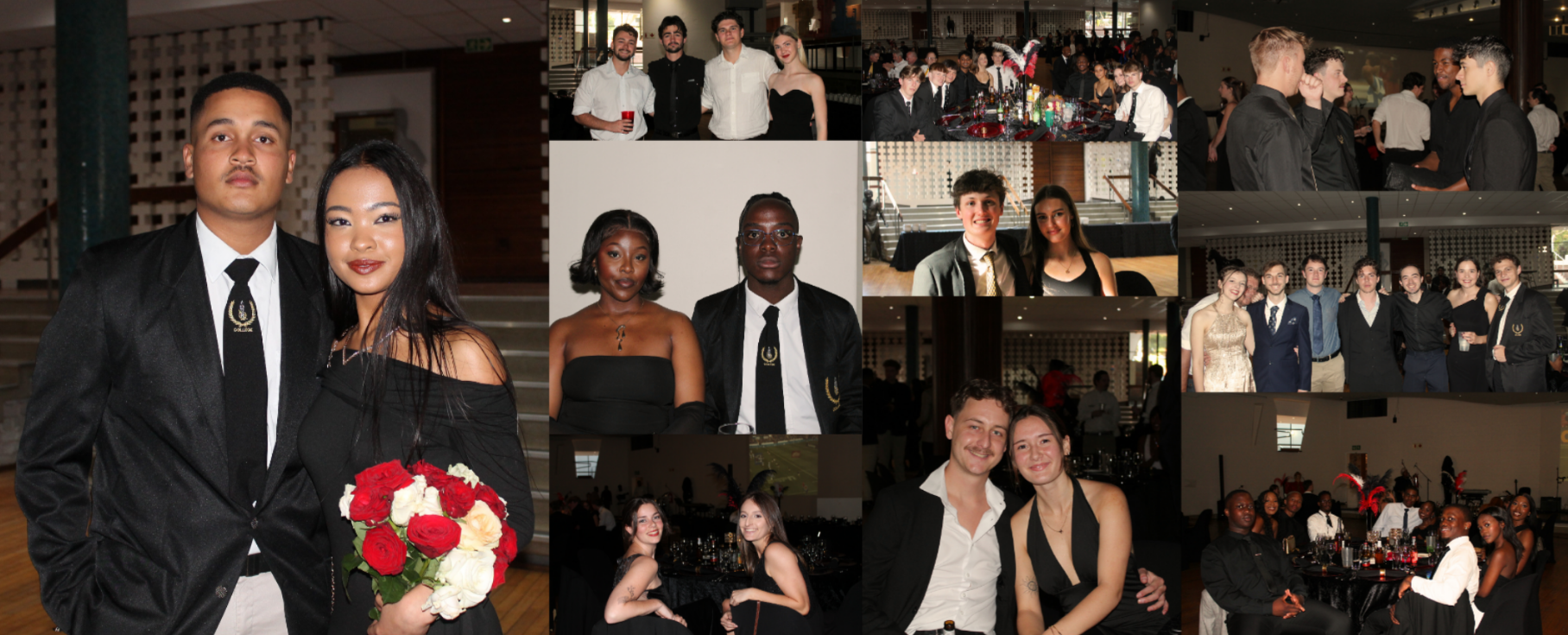
It would be negligent if I did not include College’s FeesYaar Dinner on 4 October in this article – an evening filled with camaraderie to close out the 110th chapter of College’s story with, by my count, four College mascots in attendance, including a life-size horse statue.
In true College fashion, the dinner began with quiet mingling and the Springbok vs Argentina rugby match projected at the front of Rautenbach Hall. What followed were videos made by College men to honour fellow College men. One Star Wars video in particular was composed of multiple College men speaking in different languages. This is a further measure of inclusivity to accommodate both old and new College men – a balance that College is desperately trying to maintain, so much so that multiple speakers affirmed College’s transformation. However, they emphasised that they need to stay true to Kollegetehuis. This includes College House Father Rirhandzu Golele who said, “We have evolved… [However], we [do] not forget our traditions and culture.”
Many College alumni from different generations were in attendance. The Old Ou Manne, as referred to by current College men, were the men who attended College during the years when economic sanctions began to take a toll on apartheid South Africa. When I asked one of the Ou Manne how he was finding the dinner, he exclaimed, “Brilliant!”, and then turned towards Pilane and said, “You guys are doing so well.” To this Ou Man, the College men of today are maintaining that balance and are worthy of the high praise.
After a delicious meal and refreshments, a surprise auction, organised by Pilane, was announced. A one-of-a-kind College blazer with the cost price of R1 500 was bid on and sold to the highest bidder for R4 200. When asked why he bid such a large sum, the winner said that “it’s memorabilia” and that he was just glad to contribute to the residence. This is a true example of the love exemplified by College men for their residence.
Another notable Ou Man was J.C. Strauss – a College man known for his numerous achievements and his Bill the Butcher moustache. According to The Republic of Kollegetehuis History Guide, Strauss wrote this statement regarding the outcome of World War II: “It has been a victory for the allies, yet it has been a loss for Kollege, as we have always been on Hitler’s side.” However, the history guide further states that the residence does not recognise Strauss’s “values, morals and ethics”. Yet, what message is College sending by inviting and honouring J.C. Strauss? Was this invitation to, arguably, one of their most important events of the year intentional or wilfully ignorant?
It is clear that College men cannot all be painted with the same brush. For better or for worse, College is College, and with that name comes responsibility as one of the only residences that has truly grown alongside the University of Pretoria.
