
On 20 July, the Student Representative Councils (SRCs) of several of South Africa’s top universities released a joint statement condemning the exploitation of students through high accommodation costs and the failure of the NSFAS’s accommodation cap. The statement was made against the backdrop of NSFAS’s failures within the past year, as well as the questionable business practices of student accommodation providers countrywide.
The statement made by the SRCs of the University of the Witwatersrand (Wits), Stellenbosch University (SU), the University of Johannesburg (UJ), and the University of Cape Town (UCT) began by detailing how NSFAS had failed to report student accommodation providers to the Competition Commission for possible collusion and price gouging despite announcing that they would do so back in 2023. Additionally, the SRCs highlight the detrimental effects that the NSFAS accommodation cap has had on students. Introduced in 2023, the cost cap allocates a maximum amount per annum towards student accommodation, a decision that would – according to NSFAS – manage the unregulated and increasing costs of student housing. However, as explained by the statement, the cap has only left students struggling, as many bear the brunt of skyrocketing accommodation prices with no means to deal with the costs.
The statement further detailed the shortcomings of the accommodation cap. The SRCs provided that the cap fails to consider the differences between regional rates and the difference in the number of beds priced below the cap around each university compared to the total number of NSFAS beneficiaries. The cap makes a distinction between metro and non-metro areas, with the latter receiving a lower cap. The SRCs claim that this classification system is illogical as “non-metro” areas such as Stellenbosch receive less funding despite the rental market being significantly more expensive than other recognised metro areas. As a result, Stellenbosch University must apply annually for their classification to be reviewed, leaving students unsure of the accommodation allowance they will receive and consequently making it difficult to secure housing in advance.
The difference between the actual rental costs and the NSFAS cap has created a shortfall that has severely affected NSFAS-funded students for the past three years. Oftentimes, students are unable to graduate despite completing their degree because of the debt owed to their respective universities. Furthermore, many students are prevented from pursuing postgraduate degrees due to fee blocks that can be directly linked to the cap. The accommodation allowance provided seldom covers full student housing fees. As a result, learners find themselves locked in disputes with private landlords who demand monthly top-ups that they cannot afford – an issue that has been discussed extensively throughout the year.
Within the statement, the SRCs call on the Department of Higher Education and Training and the Competition Commission to intervene, demanding that university-owned residences must be subsidised and never be used as profit-making mechanisms by institutions. They also called for the strict regulation of private student accommodation prices to prevent the extortion of students. The statement also highlighted how the issue of exorbitant housing costs is not an issue exclusive to NSFAS-funded students. As such, the accommodation cap cannot be the solution to the problem. It should be noted that, at the time this article is being written, NSFAS has yet to announce the meal and rental allowance rates for 2026.
The representative councils concluded by demanding the following immediate actions: the removal of the NSFAS accommodation cap, that action should be taken by the DHET and the Competition Commission to regulate the pricing of student accommodation across both public and private sectors, and that the 2026 NSFAS rates be announced.
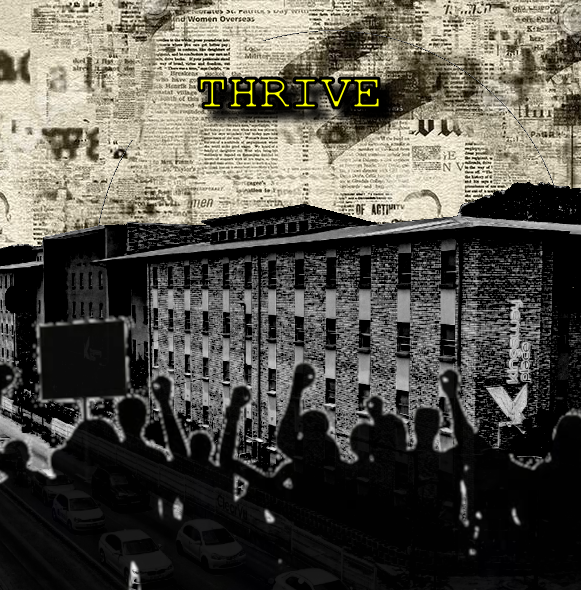
This statement was unsurprising considering the numerous protests, strikes, and marches that have taken place throughout the year in response to NSFAS’s failings and the exploitative business practices of private student accommodations. Notably, the events that unfolded at several Thrive Student Living accommodations in Johannesburg may have been the catalyst for the SRCs’s united front. On 5 and 11 June, the University of Johannesburg EFF Youth Command (UJ-EFFYC) held a “Thrive Student Living Shutdown” at multiple Thrive buildings in Johannesburg, calling for the removal of top-up fees for NSFAS-funded students. During the protests, Thrive management had placed their buildings on lockdown, trapping residents inside from 09:15 onwards. Despite presenting proof to management that they were writing exams at the time, many students were still prevented from leaving the building and subsequently missed their exams. In a video posted on the “EFFYC UJ APK” TikTok page, a Thrive staff member speaks to protesters, explaining that management is aware that some students have missed their exams and that Thrive will communicate with UJ in order to resolve the issue. She further goes on to condescendingly urge the protesters to remain peaceful.
Following the shutdown, the UJ-EFFYC released several statements that detailed how they will open a case against Thrive Student Living regarding the restriction of students during the protests. Additionally, they provided that Thrive has taken legal action against four UJ-EFFYC leaders, demanding a payment of R450 000 and the removal of all social media posts relating to the protests.
At the time this article is being written, there have been no updates on the case against Thrive or the legal action taken against the UJ-EFFYC leaders. Ultimately, the protests resulted in the removal of top-up fees for all sharing rooms, with single rooms still being required to pay additional costs at a reduced price of R800 per month.
The conversations surrounding student exploitation by institutions meant to benefit them have been discussed ad nauseum, with little ever being done to resolve the issue. However, the uniting of student leadership across the country as seen above may be just what is needed to tip the scales in the right direction.
Visual: Daniel Green
