
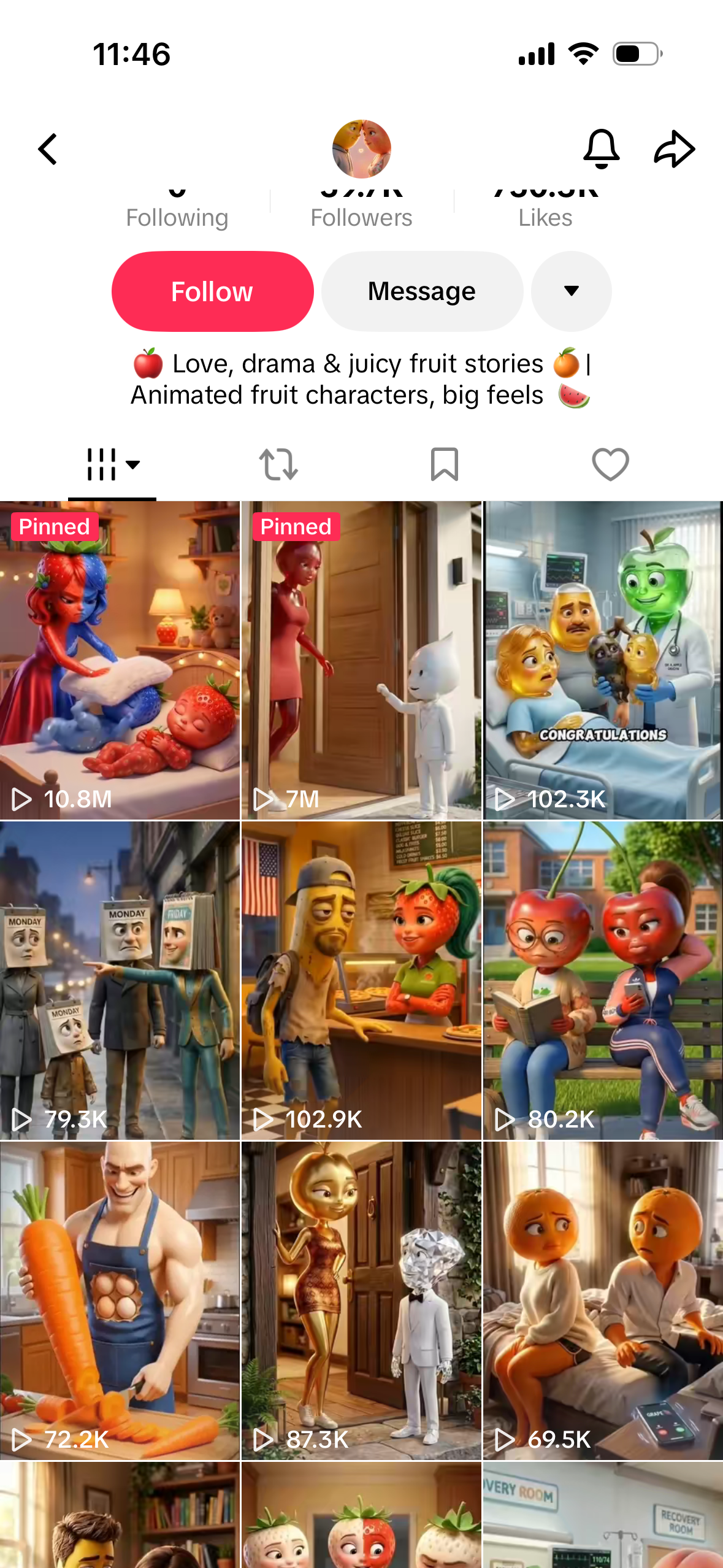
AI fruit and vegetable videos seem innocuous on the surface, do they not? A strawberry scolding you for storing it in the cabinet instead of the fridge in an airtight glass jar… Well, AI produce has gone through quite a bit of an evolution. The strawberries are now wearing thongs, people!
Initially, AI fruit and vegetable videos were somewhat informative, provided you could bear to watch a minute-long video of uncanny produce telling you how to store and cook them properly. Who knows how we used to do those things before AI existed. What is important to note about these early iterations of AI produce videos is that, other than being a waste of water, they were generally harmless thematically. The same, unfortunately, cannot be said for their successors. The new generation of AI fruit and vegetable videos has taken a more sexual, violent turn. The female figures have become progressively sexualised, portrayed as untrustworthy, promiscuous, and objects of humiliation and domination.
The story usually goes as follows: a highly sexualised strawberry wearing lingerie marries a banana, cheats with an eggplant, and gives birth to a cucumber because, shock horror, she cheated on the eggplant too. So, what if Bananito hit and degraded Strawberina for her infidelity? Who cares? It is not like these are real people; they are quite literally AI versions of a strawberry and a banana. But that is precisely what makes these videos so disturbing: the messaging and the visuals of the videos juxtapose each other. It is easy to ignore the blatant abuse of the female characters when it is overshadowed by colourful, gimmicky AI slop. These problematic themes are not only embedded in the storylines, but in what the fruits themselves represent. Female fruits/vegetables are usually yonic (resembling female genitalia), such as peaches, grapefruits, and plums. Conversely, male fruits/vegetables are usually phallic (resemble male genitalia), such as eggplants, bananas, and cucumbers. The harmful and intentional symbolism behind these videos and their characters aids in desensitising us to violent and aggressive content, particularly towards women. So, can we in good faith say that in these videos a strawberry is just a strawberry and a banana is just a banana?
A large contributor to the popularity of these AI fruit and vegetable videos is our algorithms, because the very nature of these videos is built to make us keep watching. When a video is colourful, absurd, or shocking, it is more likely to grab our attention, and we are more likely to comment on it or share it with others just so that we can be collectively bewildered. The system sees this as us enjoying the videos, so it keeps recommending the content to us. Over time, the videos become more extreme and more sexualised because ultimately, algorithms prioritise engagement over ethicality.
These AI produce videos serve as a reminder that not everything that seems harmless online is harmless. It is up to us to sift through what is rotten, pun intended, and have enough discernment to recognise the hidden dangers behind what we consume, since our algorithms unfortunately do not have moral compasses. So, the next time Fruit Love Island pops up on your for-you page, just watch the real one instead – it is only mildly less degrading towards women.
Sourced
