

In a quiet but deliberate pushback against doomscrolling culture, the University of Pretoria (UP) Library has introduced reading robots designed to get students, staff, and even the broader community reading again, one short story at a time.
“The reason behind the project is to get people to read again,” says Isak van der Walt, Acting Deputy Director: Scholarly Communications, Digital Services, and Systems at the UP Library. “People do not really read anymore, not just academically, but fiction, short stories, and poems, because they are so used to consuming content on their phones in 10- or 30-second snippets, and they do not really interact with what they are reading.”
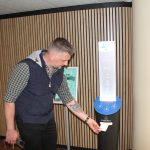
The reading robots, officially known as “Short Edition Dispensers”, were imported from France, making UP “the first in South Africa” and “the second in Africa” to host the technology. With the press of a button, students or staff can print a one-, three-, or five-minute story with no phone, no Wi-Fi, and no login required.
“The idea is also to get you away from your phone,” Van der Walt explains. “When you print out that one-, three- or five-minute read, it takes you away from your phone for that moment. Your attention span is focused on that specifically.” He adds that the physical nature of the experience matters. “By pressing a button and committing to taking a piece of paper, you are actively choosing to read. It is something tangible.”
“Since the 15th of August, we have dispensed 3 170 stories,” says Van der Walt. “At first, there was just one machine, and the majority of that count came from that single dispenser.” The machines are intentionally mobile. One dispenser is currently housed in the library while another rotates through high-traffic areas such as the coffee shop in the Information Technology building. “While you wait for your coffee or food, instead of scrolling, grab a story,” Van der Walt says. “We also want to place them in locations such as client service centres where students are waiting for consultations.”
Accessibility and outreach are central to the project. Smaller portable “story cubes” are used for campus activations and community engagement. “We engage with schools, old-age homes, and outreach events,” he explains. “Even in rural areas with no connectivity, the stories are already downloaded onto the machines.”
Content is carefully curated and highly customisable. “We have complete control over genres, languages, and themes,” says Van der Walt. “We prioritise feel-good, light reading, and we filter out mature or inappropriate content.” The machines can also be themed for events such as Pride Month, exam periods, or Valentine’s Day.
Perhaps the project’s most exciting aspect is its creative potential. “Students and staff can submit their own stories,” Van der Walt says. “We want to build a UP-specific collection, our own voices and our own stories, and move away from content that is very Euro- and Western-centric.” Selected work may even be published internationally, with prizes and royalties attached.
At its core, the initiative is about reclaiming focus and having fun. “It is a fun project with a lot of potential,” Van der Walt concludes. “Sometimes, you just need a short break, a story, and a moment to think for yourself again.”
Visual: Jason Visser
