
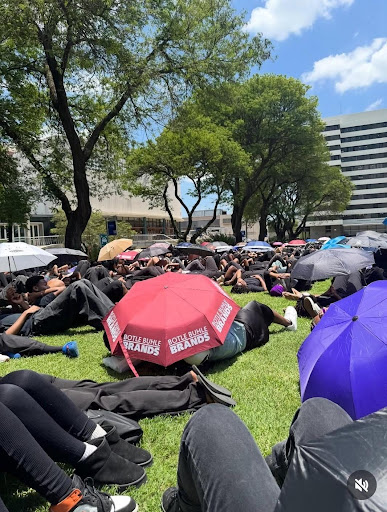
In November 2025, Women for Change, an organisation dedicated to supporting victims of gender-based-violence (GBV), initiated a nationwide campaign in an attempt to have the South African government declare GBV a national disaster. The campaign culminated in a “Women’s Shutdown” that took place on 21 November, in which all women and members of the LGBTQIA+ community across the country were encouraged to refrain from all paid and unpaid labour for the day. Supporters also participated by wearing all black, not spending money, and withdrawing from the economy on the day of the shutdown. During the shutdown, several silent “lie-downs” were held throughout the country at 12:00. Demonstrators would lie down for 15 minutes to honour the 15 women murdered every day in South Africa. Throughout November, the shutdown inspired numerous anti-GBV protests across the country and encouraged many victims to speak out. By the end of the campaign, GBV had been declared a National Crisis by the government.
Before 21 November, anticipation for the shutdown had grown online as supporters had changed their profile pictures to the colour purple across all social media platforms in order to spread awareness about the campaign. Enthusiasm for the shutdown sparked protests throughout university campuses. An instance would be at the University of the Witwatersrand (Wits) in which student protests, beginning on 10 November, took place in response to reports of alleged sexual assault committed by WITS-SRC and WITS-EFF Youth Command (WITS EFFYC) member Musawenkosi Mavuso.
PDBY spoke with Ntokozo Nemaorani, a third-year BCom student studying at Wits, who attended the first protest. Nemaorani detailed how swiftly students had mobilised, providing that the march was organised about three hours after the victim had reported the incident. The protests were sparked by WITS-EFFYC who released an official statement on their Instagram account hours before the protest took place, detailing that the organisation had received reports of an alleged rape incident. The statement provided that although allegations implicating Mavuso were circulating, he was not directly named by the victim, but additional claims of sexual harassment involving him had surfaced. The statement concluded with a call for students to wear purple in solidarity as they met at the Matrix, the WITS student hub, later that night.
Then, the WITS-EFFYC released multiple follow-up statements on their official Instagram account, detailing that the WITS-SRC had moved to remove Mavuso from the SRC and that he had been expelled from the EFFYC, additionally calling for Mavuso to be expelled from the university altogether. The organisation had also inquired with the university regarding the recovery of CCTV footage of the alleged incident, requesting that if found, the footage must be given to SAPS for a criminal investigation. However, the university had provided that this process was being delayed due to internal processes.
Following a mass meeting with the Dean, the EFFYC concluded in a final statement that the Dean was only concerned with maintaining the reputation of the university and was purposely delaying action on the matter. They concluded by encouraging victims to report incidents directly to the police and not rely on the university’s institutional processes. At the same time, the WITS-SRC had also released multiple statements largely aligning with the sentiments of the EFFYC. Mavuso was ultimately suspended from the WITS-SRC, and it is currently unknown whether any legal action has been taken against him.
Nemaorani ultimately expressed disappointment in the handling of the Mavuso case, saying, “It wasn’t the first time that [a] specific SRC member had been reported… I do feel like more should’ve been done way before that incident had happened.” The events at Wits showcase how the shutdown encouraged students to stand up against injustice and make efforts to hold perpetrators accountable.
During the shutdown, the UP-SRC held a lie-down on the Aula grass at the UP Hatfield campus. The demonstration saw a large volume of UP students in attendance, including Mazviita Pasi, a third-year LLB student. Pasi highlighted the emotional aspect of the event, recalling the strong emotions invoked by the subject matter of the shutdown and the large number of students that appeared on campus to show their support. They further said, “It sends a positive message to anyone that might have been there who was a victim that they have this community that’s fighting behind them.” When asked about the importance of youth participation in political demonstrations, Pasi underlined the youth’s responsibility to stand up against injustice, especially with the youth’s ability to question the status quo and challenge traditional gender roles where the older generations do not. When speaking on the role of student structures such as the UP-SRC, Pasi said that it is essential for these institutions to stand against injustices such as GBV alongside students. They explained that it is their duty to speak for students, including those who have been victims of GBV. Pasi adds that public support from the SRC shows that victims are not alone. In regard to GBV’s classification as a National Crisis, Pasi laments the lack of practical and effective measures implemented by the government in order to combat the issue. They concluded by speaking on the lasting impact that the shutdown had left behind, highlighting the discussions it had sparked about online activism and the success of the online campaign itself, saying, “Being able to see that online activism happening sends a message to people that they can do something even from their own home.”
Ultimately, the Women’s Shutdown made waves throughout the country – not just on 21 November, but throughout the entire month. The campaign had sparked mass movements across the nation, encouraged victims to speak out, pushed for perpetrators to face consequences, and kept GBV in the public consciousness. Although GBV has been classified as a National Crisis, the lack of statutory actions by the government left much to be desired.
PDBY will release an interview with Women for Change that takes a retrospective look at their campaign as an online exclusive.
