
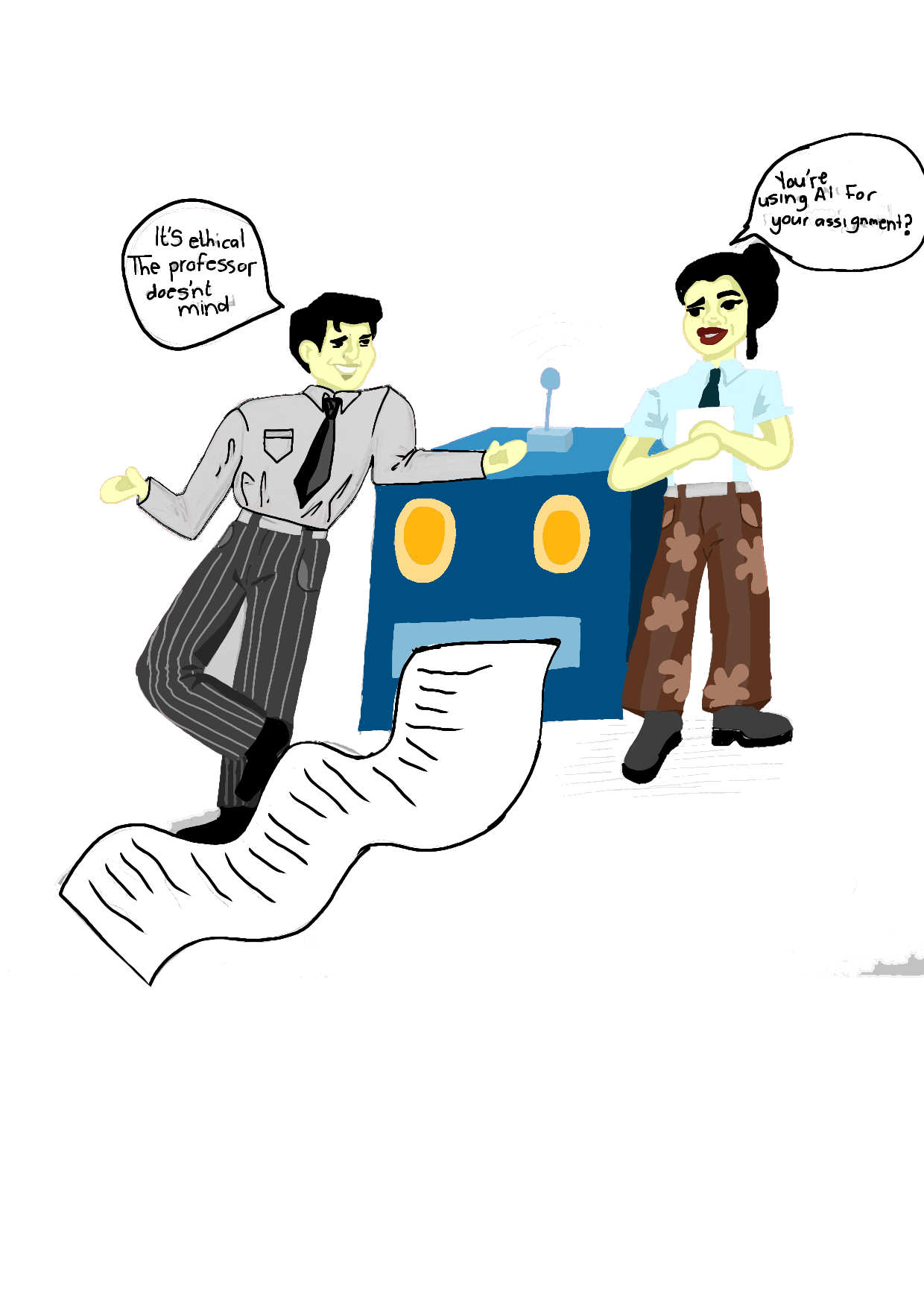
The University of Pretoria recorded approximately 53 AI-related disciplinary matters between 2024 and 2025, all of which were referred to its legal department. Generative artificial intelligence has shifted from a classroom novelty to a permanent feature of academic misconduct.
The figure, confirmed by UP spokesperson Rikus Delport to ITWeb in March, places UP alongside the University of Johannesburg (UJ), the University of South Africa (Unisa), and the University of Cape Town (UCT), all of which reported rising or persistent cases of students using tools such as ChatGPT, Google Gemini and Microsoft Copilot in ways that breach assessment rules. At UP, the cases span examinations, tests, assignments, projects and coding tasks.
The numbers tell only part of the story. Behind each case sits a harder question: how does a university prove that a student used AI, and what should be done when AI detection tools themselves are unreliable? The challenge extends beyond detection to broader debates about academic integrity. Generative artificial intelligence has shifted from a classroom novelty to a permanent feature of academic misconduct.
The detection dilemma
Delport told ITWeb that AI-assisted cheating is harder to detect than conventional copy-and-paste plagiarism, because AI-generated text can be “original” in form. “AI detection tools are not sufficiently reliable for high-stake decisions and risk both false positives and false negatives,” he said.
UP’s preferred approach is the triangulation model: a student’s AI declaration, drafts and version history, working notes, code or source checks, and, where needed, a brief oral clarification to confirm authorship. “The analysis goes beyond looking at a Turnitin report and still requires the input of the subject matter expert,” Delport said.
That caution has become national orthodoxy. UCT discontinued its use of the Turnitin AI score feature in October 2025. Stellenbosch University (SU) discontinued Turnitin’s AI text detection functionality at the end of 2025, and the University of the Free State (UFS) announced that it would stop using AI detection software from 1 July. Wits University says it has never used such tools.
“So-called AI detectors are widely regarded as unreliable and prone to both false positives and false negatives,” UCT spokesperson Elijah Moholola told ITWeb. “Continued reliance on such tools risks undermining academic fairness and student trust.”
Wits university senior director of academic affairs Prof. Nicole De Wet-Billings bluntly stated, “Detection tools were known from the very start to produce false positives and negatives and should never have been used.”
The reliability problem is not evenly distributed. A 2023 Stanford University study found that seven leading detectors flagged 61% of authentic, human-written essays by non-native English speakers as AI-generated, and that 97% were flagged by at least one tool. AI thought leader Johan Steyn, told ITWeb that the bias is “baked into the architecture,” because detectors measure perplexity, or how predictable writing appears. And predictable, simple prose is exactly what a student writing in a second or third language produces.
For a multilingual campus such as UP, that finding is not abstract. It goes to the heart of fairness.
What UP actually permits
UP’s public position, set out in the university library’s AI guidelines, is neither prohibition nor laissez-faire. “The work you submit for assessment must represent your own thinking, your own analysis, and your own writing,” the guidelines state. Submitting AI-generated content as one’s own, in whole or in part, without permission and disclosure, constitutes academic misconduct under UP’s Academic Integrity Policy.
The guidelines permit brainstorming, grammar and language checking, generating search keywords, using AI to explain concepts, drafting a rough outline that is then substantially revised, and coding assistance where the intellectual content remains the student’s own. They prohibit submitting AI-generated text, using AI to paraphrase sources, citing AI-fabricated references, and passing off AI analysis as one’s own.
Crucially, the rules are module-specific. Individual lecturers set the AI rules for each assessment, and the module outline and assignment brief always take precedence. Where an assignment is silent on AI, the guidelines advise students to treat AI as prohibited. “Do not assume that silence means permission,” it states.
Disclosure is detailed: students must name the tool and version, describe what it was used for, provide the prompt where required, and explain how they engaged with the output. Even permitted AI use that goes undisclosed violates the policy.
A policy written in every module and interpreted by individual lecturers is only as strong as the assessments it governs, and UP’s own account of its cases points to where it is strained hardest. “While the incidents mostly arise in written form assessments, we have periodically received complaints emanating from calculative assessments and within the area of coding,” Delport said.
The faculty that teaches the tools
Coding and calculative work sit overwhelmingly in the EBIT faculty, which houses the Department of Computer Science and the university’s densest concentration of AI expertise. The faculty is on both sides of the problem: it produces much of the knowledge that makes detection difficult, and it sets assessments in which authorship is difficult to prove.
Code is the hardest case. A program either runs or it does not, but authorship is invisible in the output. A student who can read, debug, and extend generated code may still be learning; a student who cannot may still submit work that passes. That is why Delport’s reference to “code or source checks” matters more in a practical than in an essay.
EBIT also teaches the technology directly. COS 314 (Artificial Intelligence 314), is an 18-credit third-year module taught through two lectures and one practical a week in which students build game trees, a neural network, and a genetic algorithm. It is offered to students studying computer science, information and knowledge systems, multimedia, applied mathematics and physics. The faculty’s standing sharpens the point: UP was ranked first in South Africa and second in Africa for AI research output and impact in an EduRank analysis published in August 2025.
That leaves the EBIT faculty teaching students to build the tools that make misconduct easier to commit and harder to detect. Prof. Alta van der Merwe, EBIT Deputy Dean for Teaching and Learning, saw it early. “Being in education, I do have concerns. We will have to rethink the writing of reports and acknowledge that the writer of a report can use tools such as OpenAI,” she wrote in ITWeb on February 2023. Three years on, that “rethink” is the live question in the faculty that teaches the tools everyone else is trying to police.
What students say
PDBY’s own survey on AI use and academic integrity suggests that the gap between policy on paper and policy in practice may be wider than the university would like.
Tshepiso Vhengani, a third year Computer Science student, responded to the survey stating that they use AI frequently for academic work, except where assignments explicitly prohibit it, adding that they use it smartly to support their learning, understand concepts, access information faster, and study more efficiently. They described using AI for tasks ranging from working through PDFs to writing code.
Vhengani reported being only somewhat familiar with UP’s policies, disagreeing that lecturers had clearly explained what is and is not allowed, adding that students do not generally understand the consequences of AI-related misconduct. They also said they worry about being falsely accused and doubted that the university had a reliable way of proving that work was AI-generated.
Vhengani’s proposed remedy was not stricter policing, but a different culture. Arguing that UP should encourage AI use rather than create “a culture problem” in which students feel as though using AI is cheating.
A wall or a curriculum?
The debate at UP is therefore not simply about catching cheats. It is about whether a university can enforce integrity without eroding trust, and whether it can embrace innovation without abandoning the skills that a degree is meant to certify.
UP’s triangulation model, which relies on evidence, drafts, oral clarification and subject expertise, is more labour intensive than a Turnitin report and harder to scale. The library guidelines are candid that AI policies are evolving and that module level rules vary. Students, meanwhile, are navigating a patchwork of expectations with uneven guidance.
Delport’s assurance that UP handles suspected misuse through a fair fact-finding approach and proportionate responses will be tested as the cases accumulate. The deeper test is whether UP can move from policing AI to teaching students how to use it responsibly, a shift that UCT, Stellenbosch University, the University of the Free State, and Wits have already begun, and one that students themselves appear to want.
For now, the 53 cases are both a warning and a prompt. They show that AI is no longer a future problem for academic integrity at UP. The question is whether the university’s response will be a wall or a curriculum.
Visual: Lunathi
