
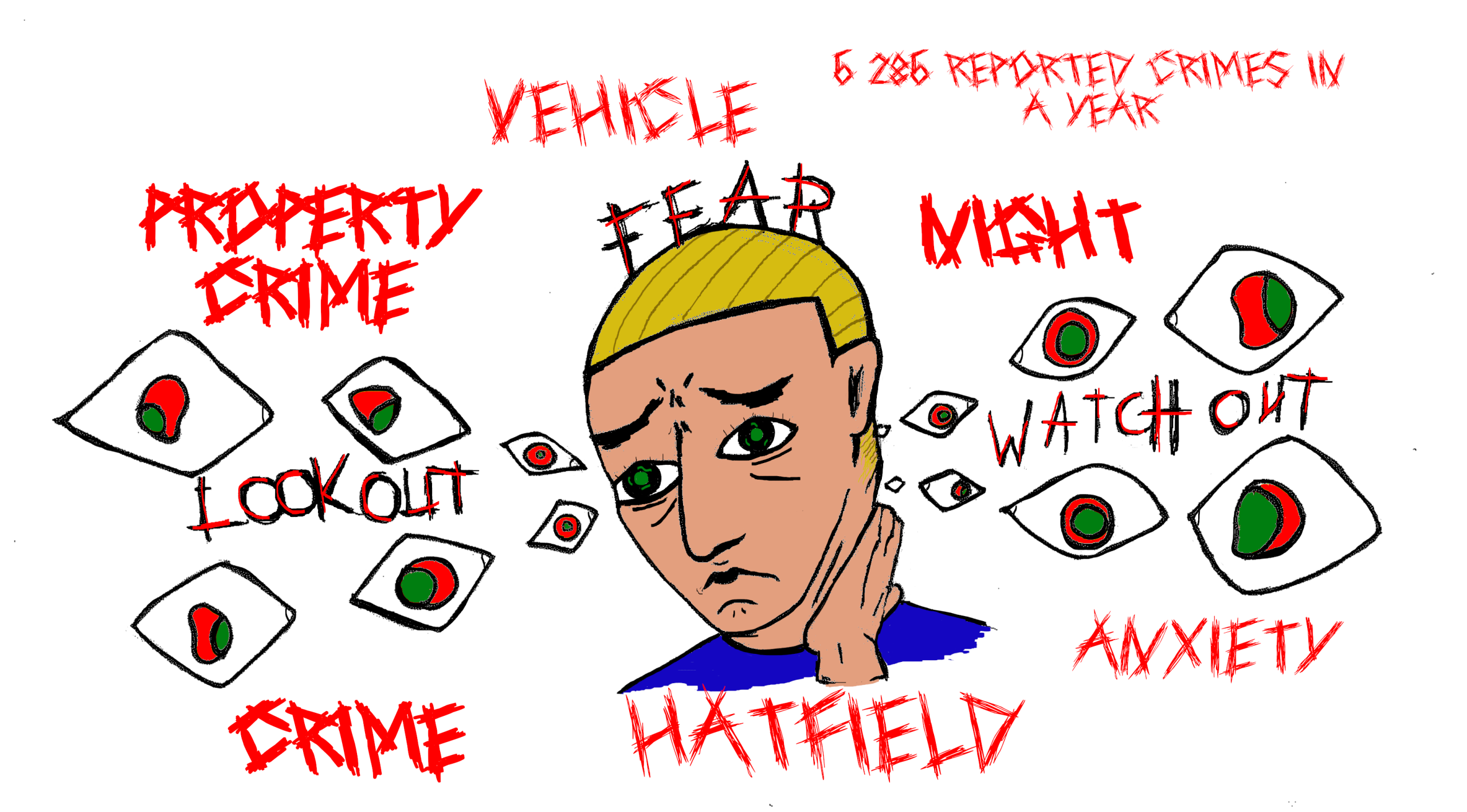
Fifteen minutes. That is roughly how long it takes to walk from the Hatfield campus to a private residence in Hatfield, and for many University of Pretoria (UP) students it is the most dangerous part of their day. In a PDBY Instagram poll, 84% of respondents said they did not feel safe walking in Hatfield after dark.
The crime figures tell a different story. The Brooklyn police station, which polices Hatfield and its neighbours, recorded 6 286 crimes between April 2025 and March 2026, 6.2% fewer than the year before. Property crime dropped by 19.4% and violent crime by 13.2%. By the numbers, the streets are getting safer. By the students’ account, they are not.
The reason is partly a matter of geography. UP’s security operation is formidable, and almost all of it faces inward: access controlled gates, 24 hour patrols, CCTV, an Operational Management Centre that answers at any hour. Each protects the campus. None of them follow a student through the gate at 22:00. The risk students describe begins exactly where the University’s jurisdiction ends.
UP knows this, which is why the “Green Route” exists. Between 18:00 and 06:00 a security officer will walk a student to their residence, their vehicle or the streets immediately around campus. Many students do not know it is there. Onesmo Mollel, a first year LLB student, has used the Green Route and says it makes studying late on campus easier. A student who asked to remain anonymous had never heard of it,and avoids Hatfield after dark. Zinhle Bhembe, a second-year education student, wants an emergency app that works without Wi-Fi because the network is least reliable outside campus when she needs it most.
The same survey measures the drop precisely. Bhembe and Musa Mbengwa, who is also a second-year education student, measure the drop precisely. Bhembe rated her safety two out of ten at night, Mbengwa put it at one. Nothing about the campus changes between those hours. Only the walk home does.
UP’s answer is that safety is shared. According to the Department of Security Services website, security is described as “a shared commitment” and calls on students to play an active role in ensuring their own safety by adopting precautionary measures such as walking in groups, concealing mobile phones, and not stopping for strangers. The advice is sound. It is also a confession. Every instruction assumes the street outside the gate is unsafe, and that the student, rather than the institution, must absorb the difference.
Some students have taken that further than the university intended. AfriForum Youth, which has pressed UP management on monitored parking and CCTV coverage, is organising student neighbourhood watches, WhatsApp groups, and self-defence training. “Students must take safety into their own hands,” said Yvonne Gerber, the organisation’s development officer. The logic is hard to fault and easy to regret: the more students guard themselves, the less anyone else has to.
The 84% is not a misreading of the statistics, and it is not a verdict on the officers who walk students home. It is the arithmetic of a student who lives just beyond the route, who has never heard of the Green Route, or who has to cross the road alone because a lecture ran late. Until those students are counted, the crime rate will keep falling and the fear will keep holding.
Visual: Daniel Green
